
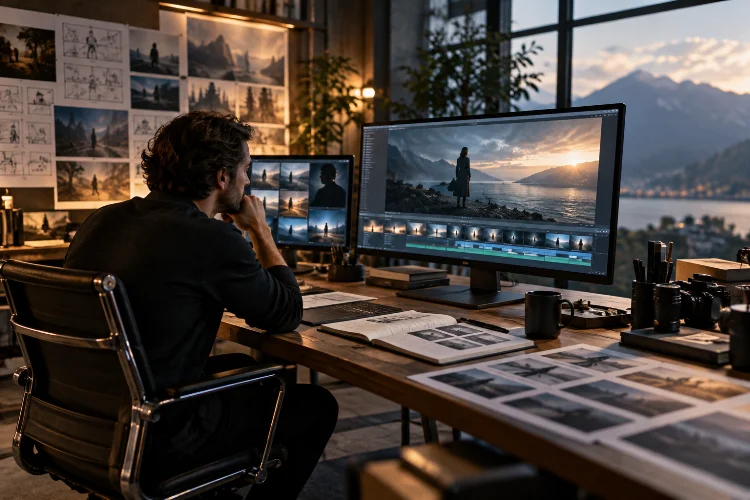
Have you ever watched a movie scene that lasted only a couple of minutes but somehow told you more about a character than an entire conversation could?
Maybe it was an uncomfortable silence, a carefully framed close-up, or a seemingly ordinary interaction that suddenly changed the direction of the story.
That’s the magic of cinematic storytelling.
Great filmmakers don’t simply record actors performing dialogue. They construct scenes where every camera angle, movement, sound, and visual detail contributes to a larger narrative purpose.
This is where advanced movie clip analysis through narrative scene construction becomes especially interesting.
Instead of focusing exclusively on what happens in a clip, this approach explores how the scene is built, why certain creative decisions matter, and how individual filmmaking techniques work together to communicate meaning.
Whether you’re a film student, aspiring director, content creator, or someone who loves digging deeper into movies, understanding narrative construction can completely change how you experience cinema.
And the best part? You don’t need expensive equipment or a filmmaking degree to start noticing these details.
You just need curiosity, patience, and a willingness to look beyond the obvious.
1. Understanding Narrative Scene Construction in Film
Before analyzing individual camera movements or editing techniques, it’s important to understand what narrative scene construction actually means.
Simply put, it’s the process of organizing dramatic action, visual information, performances, and cinematic techniques into a meaningful storytelling sequence.
A scene isn’t just a collection of shots. It’s a carefully designed experience that moves the narrative forward while shaping how viewers interpret the characters and events.
Why Scene Construction Matters
Imagine two characters sitting across from each other at a restaurant.
One scene might use warm lighting, balanced compositions, and relaxed conversations. Another might feature tight close-ups, uncomfortable pauses, and a table that visually separates the characters.
The basic situation is identical, but the emotional experience is completely different.
That’s because filmmakers communicate through visual relationships, not just spoken dialogue.
This process involves several interconnected elements, including dramatic structure, cinematography, production design, blocking, performance, editing, and sound.
When these elements support the same narrative intention, even a simple conversation can become incredibly memorable.
The Difference Between Watching and Analyzing
Casual viewing focuses primarily on the events unfolding onscreen.
Analytical viewing asks deeper questions about how those events are presented.
For example, why does the camera remain distant during an emotional confession? Why does a director avoid showing a character’s reaction? Why does the scene suddenly become quiet?
These questions reveal the creative decisions behind cinematic storytelling.
The goal isn’t to discover one supposedly correct interpretation. It’s to develop explanations supported by specific visual and auditory evidence.
2. Breaking Down Dramatic Structure and Narrative Beats
Every effective scene contains some kind of progression.
A character wants something, encounters resistance, makes a decision, or discovers information that changes their situation.
Understanding these dramatic movements is the foundation of a meaningful film scene breakdown.
Identifying Character Goals and Conflict
Start by asking what the central character wants at the beginning of the clip.
The objective might be obvious, such as escaping danger or obtaining information. However, it could also be emotional, like gaining approval, hiding insecurity, or maintaining control.
Next, identify the obstacle preventing that goal.
Consider the interrogation sequence in The Dark Knight (2008), directed by Christopher Nolan.
Batman wants information from the Joker, but the Joker manipulates the confrontation by controlling what Batman knows and exploiting his emotional reactions.
The apparent physical power of one character doesn’t automatically translate into psychological control.
This contrast between visible strength and narrative influence makes the scene particularly interesting to examine.
Recognizing Narrative Beats and Turning Points
A narrative beat represents a meaningful shift in action, emotion, knowledge, or power.
Think about a seemingly friendly conversation that becomes increasingly threatening.
At first, the characters appear comfortable. Then someone asks an unexpected question, another character hesitates, and the entire atmosphere changes.
Each transition creates a new dramatic beat.
In Inglourious Basterds (2009), Quentin Tarantino’s opening farmhouse sequence uses extended dialogue, controlled performances, and changing conversational pressure to build suspense.
The tension develops through gradual shifts in what the characters understand and what the audience suspects.
A useful analytical technique is to identify the scene’s initial situation, its major reversal, and its final emotional condition.
If nothing changes between the beginning and ending, consider whether the scene instead serves an atmospheric, thematic, or character-building purpose.
Tracking Information and Audience Expectations
Advanced narrative analysis also examines the seperation between what characters know and what viewers know.
When audiences possess important information that a character lacks, ordinary actions can become suspenseful.
A person opening a door might seem completely harmless. But if viewers already know someone dangerous is waiting behind it, that action becomes emotionally charged.
This difference in knowledge is central to dramatic irony.
By tracking when information is revealed or withheld, you can explain why certain scenes generate curiosity, anxiety, surprise, or anticipation.
3. Analyzing Mise-en-Scène, Blocking, and Visual Relationships
One of the most revealing aspects of movie clip analysis is mise-en-scène.
The term generally refers to the arrangement of visual elements within the frame, including locations, costumes, props, lighting, and actor positioning.
These details help filmmakers communicate ideas without explaining everything through dialogue.
How Physical Space Communicates Meaning
Consider Bong Joon-ho’s Parasite (2019).
The film repeatedly uses stairs, architectural levels, and differences between living spaces to explore social inequality.
The wealthy Park family’s spacious home contrasts with the Kim family’s cramped semi-basement apartment.
These environments do more than establish where the characters live.
They create a visual vocabulary through which the film explores comfort, vulnerability, aspiration, and class division.
For a stronger analysis, examine how characters move through these environments and whether their physical journeys reflect their changing social positions.
Blocking and Character Power Dynamics
Blocking describes where performers stand, sit, move, and interact within a scene.
Although it might seem like a technical production concern, blocking can reveal complicated relationships.
Imagine a manager standing while an employee remains seated during a difficult conversation.
The physical arrangement may suggest authority, but its meaning depends on other details, including camera perspective, performance, and context.
If the employee eventually stands and approaches the manager, the shifting positions might visually communicate resistance.
This is why meaningful scene analysis considers physical movement alongside dramatic development.
Objects, Color, and Visual Symbols
Props and colors can also become recurring storytelling devices.
A particular object might represent a memory, a promise, or a relationship. Its meaning can evolve depending on how it is introduced and later used.
In Get Out (2017), Jordan Peele transforms an ordinary teacup and spoon into disturbing instruments associated with psychological control.
The objects become frightening because of their narrative context, not because they look dangerous.
However, avoid assuming every color or background detail carries a hidden message.
A convincing interpretation should connect the visual element with recognizable patterns in the film rather than assigning symbolic meaning without evidence.
4. Decoding Cinematography and Visual Point of View
Cinematography determines much more than whether a scene looks beautiful.
Camera placement, focal length, framing, depth of field, and movement influence how viewers understand the relationship between characters and their surroundings.
Advanced film analysis investigates how these choices guide attention and support narrative development.
Shot Size and Emotional Distance
A wide shot can establish geography, reveal isolation, or show relationships between people and their environment.
A close-up, meanwhile, brings viewers closer to subtle facial expressions and emotional responses.
But close-ups aren’t automatically more intimate.
A tightly framed face might feel threatening, invasive, or emotionally disconnected, depending on the scene.
In Whiplash (2014), Damien Chazelle frequently emphasizes physical performance through intense framing and rhythmic editing.
Shots of hands, instruments, faces, and bodily exertion make musical performance feel like a demanding physical confrontation.
The effectiveness comes from the relationship between visual detail and dramatic pressure.
Camera Movement as Narrative Language
Camera movement can change the emotional meaning of a scene without altering its dialogue.
A slow tracking shot might create anticipation, while sudden handheld movement can communicate instability or urgency.
Static compositions may suggest control, emotional distance, or uncomfortable restraint.
However, these associations aren’t fixed rules.
A completely motionless camera can become deeply disturbing when the action inside the frame grows increasingly chaotic.
The important question is why a particular movement or lack of movement fits the dramatic situation.
Framing and the Power of Negative Space
Negative space refers to relatively empty areas surrounding the main visual subject.
Filmmakers can use this space to suggest loneliness, uncertainty, vulnerability, or expectation.
In Wong Kar-wai’s In the Mood for Love (2000), narrow corridors, doorways, and layered compositions frequently create a sense of emotional confinement.
The characters’ restricted physical environments echo the social and emotional boundaries shaping their relationship.
Instead of merely describing the composition as beautiful, explain how the framing reinforces the film’s central emotional conflict.
That’s when cinematography analysis becomes genuine storytelling analysis.
5. Understanding Editing, Pacing, and Narrative Continuity
Editing transforms separate shots into an organized cinematic experience.
The arrangement of images determines how viewers perceive time, space, relationships, and cause and effect.
Sometimes, the most important narrative information appears not within a single shot but through the connection between multiple shots.
How Cuts Create Meaning
Consider a character looking toward something outside the frame.
The next shot reveals an object, person, or event.
Viewers naturally connect the two images and interpret the second shot as the subject of the character’s attention.
This relationship demonstrates how editing can construct meaning beyond the content of individual images.
The Kuleshov effect is a classic concept associated with this process.
It illustrates how the context created by adjacent shots can influence the audience’s interpretation of an expression or image.
Continuity Editing Versus Disruption
Continuity editing generally aims to preserve understandable relationships between actions, locations, and time.
Techniques such as matching movement, maintaining screen direction, and using establishing shots help audiences follow a sequence.
However, filmmakers sometimes break these expectations delibrately.
Jump cuts can compress time, create visual disruption, or emphasize a character’s fragmented experience.
Match cuts connect separate images through shared shapes, movements, or ideas.
Stanley Kubrick’s 2001: A Space Odyssey (1968) provides a famous example through the transition from a thrown bone to a spacecraft.
The visual relationship links distant historical periods while suggesting a broader thematic connection involving technology and human development.
Pacing and Emotional Rhythm
Editing rhythm isn’t simply about how frequently a movie cuts.
It’s about how the duration and arrangement of shots affect anticipation, attention, and emotional intensity.
An action sequence might use rapid cutting to create urgency.
A dramatic confrontation might hold a single shot longer than expected, forcing viewers to remain with an uncomfortable emotional moment.
When analyzing pacing, notice where the scene accelerates, slows down, or creates a pause.
Then connect those changes to the character’s experience and the audience’s expectations.
6. Exploring Sound Design, Dialogue, and Cinematic Subtext
Visual storytelling receives plenty of attention, but sound is equally important.
Dialogue, ambient noise, music, silence, and sound transitions can change the emotional interpretation of an image.
A sophisticated movie scene analysis therefore considers sound and visuals as interconnected storytelling systems.
Dialogue Versus Hidden Meaning
Characters don’t always say what they truly mean.
Someone might casually ask whether another person is leaving while actually expressing fear of abandonment.
This difference between spoken language and underlying intention is called subtext.
In The Social Network (2010), Aaron Sorkin’s rapid dialogue frequently reveals competition, insecurity, and strained relationships beneath seemingly straightforward conversations.
The characters’ words matter, but so do their interruptions, reactions, and conversational strategies.
The most revealing details may appear in what someone avoids saying.
Silence and Emotional Pressure
Silence can become especially powerful when viewers expect a response.
Imagine a character receiving devastating news.
Instead of immediately introducing emotional music, the filmmaker allows ambient sound to disappear or become unusually noticeable.
This absence can make the moment feel intimate, disorienting, or uncomforable.
Silence can also direct attention toward small performance details, including breathing, eye movement, and hesitation.
Music and Sound Perspective
Music can reinforce emotion, contradict the visible action, or create associations across different scenes.
Meanwhile, sound perspective helps establish whether viewers experience an environment objectively or through a particular character’s perception.
A distant conversation might become muffled as a character experiences emotional shock.
Similarly, an ordinary ticking clock can feel threatening when emphasized during a suspenseful moment.
These techniques shape the audience’s subconcious expectations.
When breaking down a clip, listen once without watching the screen. Then watch the footage without sound.
Comparing the two experiences can reveal how much each storytelling layer contributes.
7. A Practical Framework for Advanced Movie Clip Analysis
Understanding cinematic techniques is useful, but applying them systematically is what really strengthens analytical skills.
Fortunately, you can build an effective movie scene breakdown using a straightforward repeat-viewing process.
First Viewing: Understand the Story
Choose a clip lasting approximately two to five minutes.
Watch it normally without stopping to examine every detail.
Identify the characters, their immediate objectives, the central conflict, and what changes by the end.
Then summarize the scene’s dramatic purpose in one sentence.
For example, a confrontation might begin as an attempt to obtain information but end by revealing that the apparent interrogator has lost control.
That transformation becomes the foundation of your analysis.
Second Viewing: Examine Visual Construction
Replay the clip and focus on shot composition, blocking, lighting, and camera movement.
Pay attention to who dominates the frame and how the visual balance changes.
Notice whether important objects appear repeatedly or whether the camera emphasizes particular expressions.
Instead of writing that a shot feels tense, identify the actual visual qualities producing that interpretation.
Perhaps the character is isolated in a wide composition, framed behind an obstruction, or photographed from an unusually low angle.
Specific observations make an argument stronger.
Third Viewing: Map Editing and Sound
Now examine how the scene is assembled.
Record major cuts, shifts in pacing, changes in sound, and moments when important information becomes available.
A simple timestamped analysis can be particularly useful.
For example, a hypothetical 90-second scene might introduce its conflict during the first 20 seconds, establish resistance over the next 30, and deliver a reversal near the final 15 seconds.
These numbers are only an illustrative breakdown, not a universal filmmaking formula.
What matters is identifying the relationship between timing and dramatic change.
Fourth Viewing: Connect Technique With Meaning
This is where surface-level observation becomes advanced analysis.
Rather than examining each cinematic element independently, explore how they interact.
Does the editing accelerate when the character loses control? Does the framing become more restrictive as the conflict intensifies?
Does the soundtrack disappear precisely when an emotional revelation occurs?
Look for patterns supporting a consistent interpretation.
A useful analytical sentence follows a simple logic: the filmmaker uses a specific technique, which produces an observable effect and contributes to a broader narrative idea.
For instance, you might argue that repeated doorway framing visually reinforces a character’s inability to escape social expectations.
The interpretation becomes more credible when you can point to multiple moments supporting it.
Comparing Different Scene Constructions
You can develop your skills further by comparing scenes with similar dramatic purposes.
For example, compare two arguments from different films.
One director might rely on uninterrupted long takes and restrained performances. Another might use aggressive close-ups and rapid shot-reverse-shot editing.
Neither approach is automatically superior.
The interesting question is how each construction changes the audience’s understanding of conflict, emotional distance, and character power.
Over time, this comparative method can reveal broader patterns in directorial style, genre conventions, and cinematic language.
Advanced movie clip analysis is ultimately about understanding how filmmakers turn individual creative decisions into meaningful storytelling.
Narrative beats establish dramatic movement, while blocking and cinematography shape relationships within the frame. Editing organizes visual information, and sound adds emotional depth, tension, and subtext.
The most insightful interpretations emerge when these elements are examined together rather than in isolation.
You don’t need to decode every frame or invent hidden symbolism to appreciate great filmmaking. You simply need to observe carefully, identify patterns, and support your ideas with evidence.
Ready to sharpen your cinematic storytelling skills?
Choose a memorable scene from your favorite movie, watch it several times, and try breaking down its dramatic structure, visual composition, editing rhythm, and sound design.
You might be surprised by how much storytelling is happening right in front of you.
