
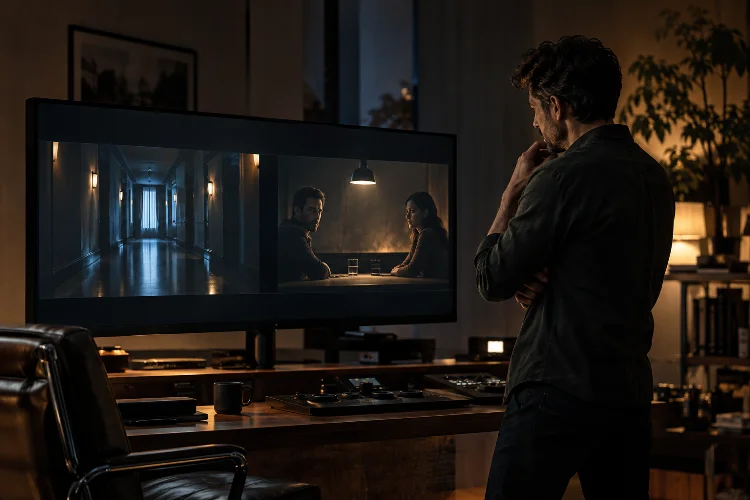
Ever watched a movie scene where almost nothing happens, yet your heart starts racing anyway?
Maybe two characters are sitting across a table, exchanging uncomfortable glances. Perhaps someone is walking down an empty hallway, or a detective is slowly approaching a suspicious building.
There’s no explosion, no dramatic chase, and sometimes barely any dialogue. Still, something about the scene makes you incredibly nervous.
So, what’s going on?
A huge part of that feeling comes from the editing.
Professional filmmakers understand that tension isn’t just created by what happens on screen. It’s also shaped by when images appear, how long shots remain visible, and what information audiences receive at particular moments.
Cinematic editing patterns that enhance narrative scene tension use rhythm, visual contrast, emotional reactions, and carefully controlled timing to build anticipation.
Some techniques accelerate the action, while others intentionally delay important moments.
The fascinating part? These choices can completely transform the same footage into different emotional experiences.
Let’s explore how professional editors create suspenseful sequences, why certain movie scenes become unforgettable, and how you can apply these techniques to your own filmmaking projects.
1. Understanding How Editing Patterns Create Cinematic Tension
Film editing is often described as the process of assembling individual shots into a complete sequence.
That’s technically correct, but it doesn’t explain why editing matters so much to emotional storytelling.
A skilled editor doesn’t simply decide which shot comes next. They determine how viewers experience uncertainty, danger, anticipation, and emotional conflict.
Why Tension Depends on Timing
Imagine a character discovering a mysterious envelope on their doorstep.
In one version, the editor immediately shows what’s inside. The mystery disappears almost instantly, allowing the story to move forward.
In another version, the camera remains on the character’s expression before revealing the envelope’s contents.
The audience starts wondering what’s written inside and why the character looks concerned.
Both versions contain exactly the same story information. However, the second creates suspense by delaying the answer.
This illustrates a fundamental principle of cinematic storytelling: tension develops through the relationship between information and expectation.
Editors decide when viewers receive important details and how long they remain uncertain about the outcome.
Emotional Stakes Come Before Editing Tricks
Walter Murch, the influential film editor known for his work on The Conversation and Apocalypse Now, famously emphasized emotion in his editing philosophy.
His Rule of Six considers emotion, story, rhythm, eye trace, two-dimensional screen relationships, and three-dimensional continuity.
The central lesson is that emotional effectiveness matters more than mechanically perfect transitions.
A technically flawless cut might preserve every spatial relationship but still undermine an actor’s performance.
Meanwhile, a slightly unconventional transition can feel completely appropriate when it strengthens the emotional moment.
For filmmakers, this means understanding a scene’s underlying conflict before experimenting with advanced editing effects.
The important question isn’t simply where to cut.
It’s what the audience should feel when that cut happens.
2. Rhythmic Editing: Controlling Suspense Through Shot Duration
One of the most effective ways to manipulate narrative tension is through editing rhythm.
Rhythm refers to how individual shots are arranged over time, including their duration, movement, and relationship to surrounding images.
Just like music, cinematic editing can establish a recognizable tempo before suddenly changing it.
Psycho: Turning Calm Into Cinematic Chaos
Alfred Hitchcock’s Psycho (1960) provides one of the most famous examples of rhythmic contrast.
The shower sequence initially presents an ordinary, private moment.
The visual pacing allows viewers to settle into the environment before the situation changes dramatically.
When the attack begins, rapid cuts fragment the action into brief, unsettling images.
According to the British Film Institute’s discussion of the documentary 78/52, the attack sequence contains 52 cuts across approximately 45 seconds.
Rather than presenting the violence through a single uninterrupted perspective, the editing combines movement, close-ups, abrupt shifts in viewpoint, and carefully timed reactions.
The audience experiences the event as chaotic and overwhelming.
What’s particularly impressive is how the editing suggests more violence than the images explicitly reveal.
Viewers mentally connect fragmented visual information, making the sequence feel extraordinarily intense.
Whiplash: Editing That Feels Like a Musical Performance
Damien Chazelle’s Whiplash (2014) approaches tension through a very different editing style.
The film follows Andrew Neiman, an ambitious young drummer whose relationship with a demanding music instructor becomes increasingly destructive.
During rehearsal scenes, editor Tom Cross uses close-ups of drumsticks, cymbals, facial expressions, and physical movements to reinforce the performance’s aggressive rhythm.
Quick transitions communicate the pressure Andrew experiences while attempting to meet his instructor’s expectations.
However, the editing isn’t simply synchronized to every musical beat.
It also creates contrast between the energy of performance and the uncomfortable moments when music stops.
A sudden pause can feel more intimidating than a rapid sequence of cuts.
In a 2015 interview published by Forbes, Chazelle and Cross discussed the relationship between musical timing, performance, and the film’s energetic editing.
Why Changing Rhythm Works Better Than Constant Speed
If every shot lasts roughly the same amount of time, viewers eventually become accustomed to that rhythm.
The sequence may remain understandable, but its emotional intensity can become predictable.
Editors often introduce variations to disrupt those expectations.
A scene might begin with relatively long shots, gradually accelerate through shorter cuts, and suddenly hold on a character’s expression.
The contrast makes the final image feel significant.
Practical insight: Try editing the same 30-second scene twice. Use rapid cuts in the first version and longer, more selective shots in the second, then compare which arrangement creates stronger anticipation.
3. Cross-Cutting and Parallel Editing Make Multiple Events Feel Connected
Some of cinema’s most suspenseful sequences don’t remain in a single location.
Instead, editors move between different characters or events, encouraging viewers to anticipate how those situations might eventually connect.
This method is commonly called cross-cutting or parallel editing.
The Silence of the Lambs: Creating Suspense Through Misdirection
Jonathan Demme’s The Silence of the Lambs (1991) uses cross-cutting to create one of the film’s most memorable surprises.
During a crucial sequence, the audience sees law enforcement officers preparing to enter a house.
The film also shows serial killer Buffalo Bill inside a residence, encouraging viewers to assume that the authorities are approaching his location.
The editing reinforces this expectation by moving between the two situations.
However, the apparent connection turns out to be misleading.
The officers are approaching a different house, while FBI trainee Clarice Starling encounters the actual suspect.
The reveal transforms the audience’s understanding of the scene.
What initially appears to be a coordinated police operation becomes a far more dangerous situation for Clarice.
The tension comes from how carefully the editor controls the relationship between separate locations.
Dunkirk: Multiple Timelines, One Emotional Experience
Christopher Nolan’s Dunkirk (2017) offers a more complex example of parallel narrative construction.
The film follows events unfolding across land, sea, and air during the evacuation of Allied soldiers from France.
These narrative strands operate across different time spans before eventually converging.
Editor Lee Smith had to maintain understandable relationships between the storylines while creating a sense of escalating danger.
The film frequently moves between soldiers awaiting evacuation, civilians traveling by boat, and pilots engaged in aerial combat.
Each transition adds another layer of urgency.
In an interview published by the Los Angeles Times, Smith discussed the challenge of combining the film’s different timelines while preserving its emotional impact.
Rather than relying on straightforward chronological storytelling, the film builds suspense through carefully organized narrative intersections.
Increasing Pressure Through Converging Events
Cross-cutting becomes particularly effective when several situations move toward a shared outcome.
Imagine a character trying to disable a security system while another person approaches the building.
A third storyline might follow someone attempting to warn them about an approaching threat.
The editor can gradually shorten the intervals between these actions.
As the events converge, audiences begin anticipating a collision between the different storylines.
This creates urgency without requiring every individual shot to contain dramatic action.
The important element is that viewers understand how the situations relate to one another.
4. Reaction Shots and Delayed Reveals Control Audience Expectations
Sometimes the most powerful image in a tense scene isn’t the threatening object or dangerous event.
It’s the reaction of someone experiencing it.
Reaction shots allow editors to communicate fear, suspicion, confusion, and emotional uncertainty through performance.
More importantly, they can delay important information while keeping audiences deeply engaged.
The Birds: Building Suspense Before the Threat Is Revealed
Hitchcock’s The Birds (1963) demonstrates how repetition and delayed visual information can create extraordinary anticipation.
During the school playground sequence, Melanie Daniels waits outside while birds gradually gather on the playground equipment behind her.
The editing moves between Melanie and the growing number of birds.
Because she remains unaware of the developing threat, viewers possess information she doesn’t.
Each return to the birds reveals that the danger has increased.
The scene doesn’t require constant attacks or frightening visual effects.
Instead, suspense develops because the audience understands that the situation is becoming increasingly dangerous.
StudioBinder’s examination of suspense techniques identifies this sequence as an example of how editing can delay action while increasing anxiety.
Why Holding on a Face Can Be More Powerful
Imagine a detective opening a confidential document.
A conventional edit might immediately show the document’s contents.
However, holding on the detective’s reaction creates a different emotional experience.
Perhaps their expression shifts from curiosity to disbelief.
The audience now understands that something important has been discovered but doesn’t know exactly what it is.
That missing information encourages viewers to mentally explore possible explanations.
Reaction shots are particularly effective during dialogue.
Sometimes watching a character listen reveals more about the emotional stakes than watching the person speaking.
A hesitant smile, averted gaze, or delayed response might communicate an entire relationship’s underlying conflict.
When Editors Should Withhold Information
Delaying a reveal works best when the audience already understands why the missing information matters.
Without an established question or emotional consequence, withholding details can feel unnecessarily confusing.
A useful approach involves establishing the important object, showing that a character reacts to it, and then delaying the complete reveal.
The duration of that delay should reflect the intensity of the moment.
Sometimes a few extra frames are enough.
In other situations, an extended reaction can create a much stronger emotional payoff.
The goal is to guide the audience’s curiosity delibrately rather than simply postponing information for its own sake.
5. Sound Bridges and Split Edits Add Another Layer of Suspense
Not every important editing pattern involves changing the image.
Sound can dramatically influence how viewers interpret cinematic transitions, especially when audio and visuals don’t change simultaneously.
Professional editors frequently manipulate these relationships through J-cuts, L-cuts, ambient sound, and carefully controlled silence.
J-Cuts: Introducing Danger Before Showing It
A J-cut occurs when audio from an upcoming shot begins before the visual transition.
Imagine watching a woman walking through a quiet parking garage.
Before the camera reveals anything unusual, the audience hears approaching footsteps.
The image remains focused on the woman as the sound becomes more noticeable.
Only afterward does the editor reveal another person entering the garage.
By introducing the audio first, the scene encourages viewers to anticipate the approaching presence.
This technique can also establish a threatening environment before characters enter it.
Distant sirens, mechanical sounds, breaking glass, or whispered dialogue can all create uncertainty when their sources remain unseen.
L-Cuts: Keeping Emotional Pressure Alive
An L-cut allows audio from the previous shot to continue after the image changes.
For example, imagine an argument between two characters.
As one person delivers a threatening statement, the editor cuts to the other person’s silent reaction while the speaker’s voice continues.
This gives the audience time to observe how the words affect the listener.
The emotional pressure remains active even though the visual focus changes.
L-cuts are particularly useful when editing tense conversations because they prevent every dialogue exchange from feeling mechanically structured.
Adobe’s guide to J-cuts and L-cuts explains how these split edits support visual continuity and more expressive scene transitions.
Silence as a Dramatic Editing Choice
Sound can increase tension, but removing it can be equally effective.
Consider a sequence built around loud machinery, distant traffic, and nervous dialogue.
If those sounds suddenly disappear, the change may feel unsettling.
The audience begins questioning why the environment has become quiet.
Silence also draws attention to subtle details that might otherwise go unnoticed.
A character’s breathing, clothing movement, or hesitant footsteps can become unusually significant.
Practical insight: Experiment with an audio-first edit before changing the picture. Sometimes introducing a sound just before the next shot creates more suspense than adding a dramatic visual transition.
6. Breaking Continuity and Using Abrupt Cuts for Psychological Tension
Continuity editing usually helps audiences understand physical space and movement.
However, there are moments when filmmakers want the viewing experience to feel uncomfortable, fragmented, or unpredicatable.
Disrupting conventional editing patterns can reflect confusion, trauma, panic, or psychological instability.
Jump Cuts: Making Time Feel Unstable
A jump cut creates a noticeable interruption in visual continuity, often by removing part of an action while maintaining a similar camera position.
Imagine a nervous character pacing inside a small room.
Instead of presenting the movement continuously, the editor removes several sections of footage.
The character suddenly appears in different positions, creating an irregular and fragmented sense of time.
This approach can communicate agitation without additional dialogue.
However, excessive jump cutting may become distracting.
If every movement is interrupted, audiences might struggle to distinguish intentional tension from inconsistent editing.
Smash Cuts: Turning Contrast Into Shock
A smash cut abruptly moves between strongly contrasting images, sounds, or emotional situations.
Imagine a quiet dinner scene where two characters exchange a meaningful glance.
Without warning, the film cuts to a chaotic street confrontation.
The sudden change creates a strong emotional interruption.
Smash cuts can also move in the opposite direction.
A loud action sequence might end with an abrupt transition to complete silence.
The unexpected contrast forces the audience to reevaluate the mood.
Montage and Fragmented Psychological Experience
Montage can compress multiple images into a short sequence while suggesting emotional or thematic connections.
For example, a character preparing for an important confrontation might be shown repeatedly checking a clock, examining a photograph, tightening their clothing, and looking toward a doorway.
Each image contributes to an overall sense of anticipation.
Rapid repetition can communicate obsession or escalating anxiety.
However, montage doesn’t automatically create tension.
The individual images must contribute to an understandable emotional situation.
Without narrative context, an elaborate sequence may feel visually impressive but emotionally empty.
The strongest editing patterns use disruption selectively, ensuring that unusual transitions reveal something meaningful about the characters or story.
7. Practical Editing Strategies for Building Stronger Narrative Scenes
Understanding professional filmmaking techniques is useful, but applying them requires experimentation.
Fortunately, you don’t need an expensive editing studio or complicated visual effects to create suspenseful sequences.
Many effective approaches involve basic cuts, carefully chosen reactions, and precise adjustments to timing.
Start by Identifying the Scene’s Central Question
Before assembling footage, determine what the audience should be wondering.
Will the character escape? Is someone hiding important information? Will an uncomfortable conversation become confrontational?
This question should guide the editing structure.
For example, if a character suspects someone is following them, revealing the follower immediately might weaken the suspense.
Instead, the editor could emphasize the character’s nervous reactions, brief glimpses of movement, and unusual environmental sounds.
The editing then develops around the audience’s uncertainty.
Build a Clear Baseline Before Changing the Rhythm
Begin with a straightforward version that communicates the scene’s geography and narrative information.
Once the sequence is understandable, experiment with changes in shot duration.
Perhaps the opening shots should remain relatively long.
As the character becomes more anxious, the editor can introduce shorter reactions and increasingly restricted perspectives.
However, avoid accelerating every shot automatically.
Maintaining contrast between longer and shorter images often produces a more convincing emotional progression.
Use Reaction Shots to Shape Emotional Meaning
Review the footage for expressions that communicate changing emotions.
These moments may not appear dramatic individually, but they can become powerful when placed at the right point in a sequence.
Consider cutting away from a speaker before the dialogue ends.
Holding on the listener might reveal hesitation, discomfort, or suspicion that the spoken words alone cannot communicate.
An additional second can sometimes transform the meaning of an interaction.
Refine the Sequence Through Sound and Micro-Timing
After establishing the visual structure, examine the soundtrack seperately.
Notice whether audio transitions feel natural and whether background sounds support the intended atmosphere.
Try introducing an approaching sound before revealing its source.
Alternatively, allow a character’s final statement to continue over another person’s reaction.
Then examine the precise position of each cut.
Moving an edit by just a few frames can change whether a movement feels abrupt, natural, or emotionally significant.
This level of precision is especially important during moments of revelation.
Test the Scene Without Explaining It
One of the most useful editing exercises is showing a sequence to someone unfamiliar with the story.
Ask what they expected to happen and which moments made them uncomfortable.
Their responses may reveal whether your editing successfully communicates the intended emotional stakes.
If viewers become confused about who is involved or where events are occurring, consider restoring additional visual context.
If the scene feels predictable, examine whether important information is revealed too early.
Remember that an audience shouldn’t need an explanation of your editing strategy to recieve its emotional impact.
The strongest results come from balancing technical decisions with natural storytelling instincts.
Great cinematic tension rarely depends on dramatic visuals alone.
It emerges from the relationship between carefully selected shots, emotional performances, pacing, sound, and the information audiences receive throughout a scene.
Films such as Psycho, Whiplash, The Birds, The Silence of the Lambs, and Dunkirk demonstrate how different editing patterns can create suspense through contrast, anticipation, and carefully structured reveals.
Whether editors use rapid cutting, extended reaction shots, parallel action, or sound bridges, their decisions ultimately influence how viewers experience the story.
The most important lesson is that tension comes from intention, not simply faster editing.
Next time you watch a memorable thriller or dramatic sequence, pay attention to when the camera cuts and what the film chooses to reveal.
Then experiment with those techniques in your own projects and discover how small editing decisions can create powerful emotional results.
