
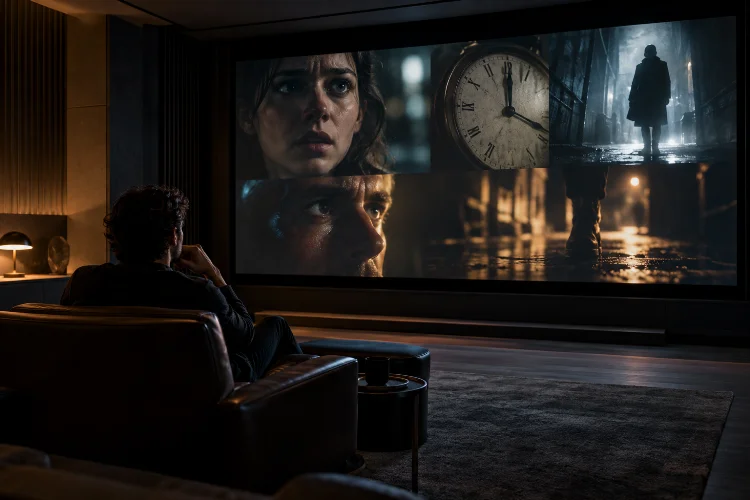
Have you ever watched a movie scene that made your heart race, even though nothing particularly dramatic was happening on screen?
Maybe the camera kept switching between nervous faces, a ticking clock, and an approaching threat. Or perhaps a heartbreaking moment felt even more powerful because the filmmaker refused to cut away.
Here’s something fascinating: those emotional reactions aren’t created by acting and music alone.
The timing of every cut plays an enormous role in how audiences experience a scene.
That’s exactly why rhythmic editing has become such an important part of modern filmmaking.
By carefully controlling shot duration, visual movement, transitions, and audio synchronization, editors can transform ordinary footage into something exciting, suspenseful, emotional, or deeply unsettling.
And the most interesting part? Viewers often don’t consciously notice these editing decisions.
They simply feel the results.
In this guide, we’ll explore how rhythmic editing creates emotional impact in movie clips, examine memorable examples from popular films, and share practical techniques that filmmakers use to control audience engagement through visual rhythm.
What Is Rhythmic Editing in Filmmaking?
Rhythmic editing is a filmmaking technique that uses the timing, duration, and arrangement of shots to establish a particular emotional or narrative flow.
Think of it as the heartbeat of a movie.
Just as music uses beats, pauses, and changes in tempo, film editing creates patterns that influence how viewers experience a sequence.
A series of rapid cuts might communicate urgency, while a prolonged shot can create suspense or emotional intimacy.
However, rhythmic editing isn’t simply about making everything faster.
It’s about choosing the right moment to cut based on what’s happening within the scene.
The Difference Between Rhythm and Pacing
Although these concepts are closely connected, they aren’t exactly identical.
Pacing describes the overall sense of speed within a movie or sequence.
Rhythm focuses more specifically on how individual cuts, actions, movements, and pauses create patterns over time.
For example, a conversation might have relatively slow pacing but contain a recognizable editing rhythm.
The camera alternates between two characters, occasionally interrupting the pattern to emphasize an uncomfortable reaction.
That interruption becomes meaningful because viewers have already become familiar with the existing visual flow.
According to StudioBinder’s explanation of film editing rhythm, editors can influence a scene’s emotional tone by controlling shot duration and adjusting the timing between visual changes.
Why Editing Rhythm Matters
Audiences naturally develop expectations when watching repeated visual patterns.
When a sequence establishes a steady rhythm, viewers begin anticipating when something might change.
A sudden interruption can create surprise, discomfort, or excitement.
This is why two versions of the same scene can feel completely different, even when they contain identical footage.
The images haven’t changed, but their timing transforms the experience.
How Editing Rhythm Influences Audience Emotions
Filmmakers frequently use editing patterns to guide attention and influence emotional responses.
These techniques work particularly well when visual rhythm complements the psychological circumstances of the characters.
Fast Cuts Create Urgency and Excitement
Rapid cutting is commonly associated with action sequences, intense arguments, and moments of escalating danger.
Imagine a character attempting to escape from a locked building.
The editor alternates between their frightened expression, a closing security door, approaching footsteps, and their trembling hands.
As the situation becomes more dangerous, the shots might become shorter.
The increasingly compressed visual rhythm can make viewers feel that time is running out.
However, fast cutting isn’t automatically exciting.
If viewers can’t understand what’s happening, the sequence might simply feel confusing.
Effective action editing balances intensity with visual clarity.
Slow Editing Builds Suspense and Emotional Depth
Longer shots give audiences additional time to examine expressions, environments, and subtle behavioral changes.
Consider a character receiving devastating news.
Instead of immediately cutting between multiple angles, the filmmaker holds on their face.
The audience watches as the information gradually sinks in.
That extended moment creates space for emotional understanding.
In horror movies, slow editing can produce a completely different effect.
A prolonged shot of an empty hallway may become increasingly unsettling because viewers expect something frightening to appear.
The suspense emerges from the uncomfortable waiting.
Changing Rhythm Creates Emotional Contrast
Some of cinema’s most powerful moments occur when editors suddenly change the established rhythm.
An intense sequence filled with rapid cuts might abruptly transition into a long, silent shot.
The contrast can communicate shock, exhaustion, grief, or emotional realization.
This technique is especially effective when the editing pattern reflects a character’s psychological transformation.
A chaotic scene followed by unexpected stillness may suggest that the character’s understanding of the situation has completely changed.
Essential Rhythmic Editing Techniques Used in Modern Cinema
Professional editors employ several techniques to control cinematic rhythm.
Some depend on precise timing, while others respond to movement, performance, and emotional context.
Metric Editing: Creating Patterns Through Shot Duration
Metric editing involves cutting shots according to predetermined lengths rather than primarily following their internal action.
For example, an editor might begin with shots lasting four seconds each.
As tension increases, those durations could gradually decrease to two seconds and then one second.
The result is an accelerating visual pattern.
The technique is associated with filmmaker Sergei Eisenstein and the development of Soviet montage theory.
As explained in StudioBinder’s overview of Soviet montage, metric, rhythmic, tonal, overtonal, and intellectual montage represent different approaches to constructing meaning through editing.
Movement-Based Editing
Movement-based rhythmic editing considers actions happening inside the frame.
Instead of cutting after a fixed number of seconds, the editor follows gestures, camera movement, or the momentum of physical activity.
Imagine someone throwing a basketball.
The first shot follows the player’s arm movement, while the next continues the ball’s trajectory toward the basket.
The transition feels natural because the motion creates continuity across both images.
This technique is particularly useful in sports sequences, dance performances, and action choreography.
It creates visual momentum without requiring extremely rapid cutting.
Tonal Editing and Emotional Consistency
Tonal editing focuses on the emotional qualities of consecutive shots.
Instead of prioritizing physical movement or fixed timing, the editor considers how each image contributes to the sequence’s atmosphere.
A melancholic scene might combine quiet landscapes, restrained facial expressions, and lingering compositions.
Meanwhile, a disturbing sequence could alternate between uncomfortable close-ups and unsettling environmental details.
The emotional relationship between those images becomes more important than their individual duration.
Breaking Established Patterns
One of the most overlooked techniques involves deliberately interrupting a visual rhythm.
Suppose a sequence consistently cuts every two seconds.
Suddenly, the editor holds a single shot for ten seconds.
That unexpected change draws attention to the moment.
Viewers may interpret the interruption as a sign that something important has happened.
The effect works becuase the previous pattern established an expectation that the filmmaker can now challenge.
The Relationship Between Music, Sound, and Editing Rhythm
Music and sound design can dramatically influence how audiences experience visual timing.
However, editing to music involves more than simply placing every cut on a drumbeat.
Great filmmakers use the relationship between images and sound to shape emotional meaning.
Cutting to the Beat
Beat synchronization is one of the most recognizable editing techniques.
Editors align visual changes with musical accents, percussion, or other rhythmic elements.
This approach can make action sequences feel energetic and carefully choreographed.
Music videos frequently use beat-matched cuts, but narrative films can employ them just as effectively.
The technique becomes particularly powerful when physical actions correspond with musical patterns.
For example, a door closing might coincide with a bass drum, while a sudden camera movement matches a musical accent.
These connections make sound and imagery feel inseparable.
Editing Against the Music
Interestingly, cutting directly on the beat isn’t always the best creative decision.
Sometimes an unexpected visual transition creates a stronger emotional response.
Imagine a romantic scene accompanied by gentle piano music.
Just before a musical phrase resolves, the editor cuts to a character leaving.
The interrupted expectation can emphasize emotional separation.
This approach introduces tension between what viewers hear and what they see.
Rather than following the soundtrack mechanically, the editor uses contrast to reinforce the story.
Sound Effects as Rhythmic Elements
Rhythmic editing also works without traditional music.
Footsteps, breathing, ticking clocks, machinery, and environmental noises can establish recognizable audio patterns.
A suspenseful scene might alternate between the sound of approaching footsteps and a character’s increasingly unstable breathing.
As the sounds accelerate or become more prominent, the editing can reinforce the changing emotional atmosphere.
Adobe’s guide to audio-visual mixing emphasizes the relationship between sound, pacing, emotion, and visual storytelling.
The lesson is straightforward: sound shouldn’t simply accompany the images. It should participate in shaping the viewer’s experience.
Famous Movie Examples That Demonstrate Rhythmic Editing
Some movies provide particularly memorable examples of how editing rhythm influences emotional storytelling.
Examining these films reveals that effective pacing depends on narrative context rather than speed alone.
Baby Driver (2017): Synchronizing Action With Music
Edgar Wright’s Baby Driver offers one of the clearest examples of music-driven cinematic editing.
The film follows a getaway driver who uses music as an important part of his everyday experience.
Many of its action sequences are carefully synchronized with selected songs.
Car movements, gunshots, footsteps, and visual transitions frequently correspond with musical beats.
The opening car chase, accompanied by “Bellbottoms” by The Jon Spencer Blues Explosion, establishes this approach immediately.
What makes the sequence special is that the editing doesn’t simply follow the music after filming.
Wright planned much of the action around specific tracks during preproduction.
In an interview with Televisual, editor Paul Machliss explains how music, sound effects, storyboards, and on-set editing helped coordinate the film’s complicated choreography.
The result creates excitement through the close relationship between character movement and musical structure.
Whiplash (2014): Editing as Psychological Pressure
Damien Chazelle’s Whiplash demonstrates how editing rhythm can communicate psychological intensity.
The film explores the relationship between ambitious drummer Andrew Neiman and demanding instructor Terence Fletcher.
During performance sequences, rapid transitions between drumsticks, cymbals, facial expressions, and physical reactions create a powerful sense of pressure.
The audience doesn’t merely listen to the increasingly intense drumming.
It experiences the musical performance through a similarly intense visual rhythm.
The climactic performance is particularly memorable because the cutting reinforces Andrew’s concentration, determination, and emotional confrontation with Fletcher.
In an American Film Institute interview, Chazelle describes rhythm and tempo as central connections between music and film editing.
The editing becomes an extension of the characters’ psychological struggle.
Mad Max: Fury Road (2015): Controlled Chaos Through Visual Momentum
George Miller’s Mad Max: Fury Road contains relentless action, rapid movement, and frequent transitions between camera angles.
Yet the editing rarely feels completely random.
Editor Margaret Sixel carefully constructed sequences that maintain forward momentum while helping viewers understand essential actions.
A major element involves keeping attention focused on important visual information.
Rather than switching perspectives without purpose, many cuts preserve a clear relationship between characters, vehicles, and threats.
The film also changes its rhythm when characters need moments of exhaustion, reflection, or emotional connection.
In her ProVideo Coalition interview, Sixel discusses the importance of rhythmic progression, narrative momentum, and responding to the natural timing of performances.
This demonstrates that strong action editing isn’t about cramming the maximum number of shots into every second.
It’s about maintaining excitement while preserving meaning.
Parasite (2019): Rhythmic Montage for Narrative Momentum
Bong Joon-ho’s Parasite uses carefully orchestrated editing to support its story of deception and social inequality.
One memorable example involves the Kim family’s coordinated plan to manipulate the Park household.
The sequence combines actions occurring across different moments and locations.
Visual transitions connect preparation, execution, and the consequences of their scheme.
The montage creates a satisfying sense of coordination while gradually increasing narrative tension.
Rather than depending entirely on speed, the scene uses precise visual relationships, repeated movements, and structured timing.
As StudioBinder discusses in its storyboard montage guide, the film’s planned camera movements contribute to the rhythm of the sequence.
The result feels both playful and increasingly unsettling, perfectly matching the story’s shifting emotional direction.
How to Apply Rhythmic Editing to Your Own Movie Clips
Understanding editing theory is useful, but applying these techniques makes the concepts much easier to appreciate.
You don’t need expensive production equipment to experiment.
Even a short sequence recorded on a smartphone can demonstrate how dramatically timing influences emotion.
Start by Identifying the Emotional Objective
Before arranging footage, decide what viewers should feel.
Are you trying to create excitement, anxiety, sadness, anticipation, or emotional relief?
Your answer should influence the editing decisions that follow.
For example, a suspenseful sequence might benefit from gradually accelerating cuts.
A scene focused on grief may require longer shots that allow viewers to observe emotional reactions.
Start with the intended experience rather than a preferred transition effect.
Build a Rough Cut Before Adding Music
Arrange the footage into a coherent sequence.
Focus on character actions, visual continuity, and narrative clarity.
Don’t worry about matching every transition to a soundtrack immediately.
Instead, examine whether the images communicate the intended story without musical assistance.
This is particularly helpful because an energetic soundtrack can occassionally disguise weaknesses in visual storytelling.
Once the rough sequence works, introduce music and sound effects to refine its emotional rhythm.
Experiment With Shot Duration
Create multiple versions of the same short sequence.
In the first version, use relatively long shots.
In the second, shorten the durations and introduce more frequent cuts.
In the third, combine fast sections with deliberate pauses.
Compare how each version changes the emotional experience.
You may discover that a simple reaction shot becomes more meaningful when held slightly longer.
Alternatively, shortening a transition might improve the urgency of an important action.
Use a Simple Timing Experiment
Imagine editing a 30-second suspense sequence.
Begin with five shots lasting four seconds each, followed by four shots lasting two seconds and two shots lasting one second.
This creates a basic acceleration pattern across eleven shots.
The structure isn’t a universal editing formula, but it provides a practical starting point.
Adjust the durations according to movement, performance, and the needs of the scene.
When necessary, interrupt the accelerating pattern with a longer pause.
That contrast can become more emotionally powerful than continuous fast cutting.
Review the Sequence Without Sound
One useful exercise involves watching your edited clip on mute.
Without music influencing your judgement, focus on how naturally the images connect.
Pay attention to repeated movements, visual distractions, and moments that feel rushed.
Then listen to the audio separately.
Finally, combine both elements again and determine whether they support the same emotional direction.
Professional editing is rarely completed through a single attempt. Experimentation and revision are essential parts of discovering the right visual rhythm.
Common Rhythmic Editing Mistakes and How to Avoid Them
Even technically polished movie clips can lose emotional impact when their editing rhythm becomes inappropriate.
Understanding common mistakes helps filmmakers make more intentional decisions.
Cutting Too Frequently
Fast transitions can create energy, but excessive cutting may overwhelm viewers.
When audiences constantly need to reorient themselves, they have less opportunity to appreciate performances or understand the environment.
Allow important actions and expressions enough screen time to register.
Sometimes removing a cut makes a scene more effective.
Following Every Musical Beat
Perfect synchronization can become predictable when every transition follows the same musical pattern.
The sequence might begin resembling a mechanical slideshow rather than meaningful cinematic storytelling.
Introduce variation by allowing certain shots to continue across several beats.
You can also place important transitions slightly before or after musical accents.
These small changes help prevent the rhythm from feeling overly repetitive.
Ignoring Emotional Pauses
Editors sometimes become so focused on maintaining momentum that they forget the value of silence and stillness.
Yet emotional pauses give audiences time to process significant moments.
A character’s reaction after an argument may matter more than the argument’s fastest exchange.
Leaving room for that reaction can strengthen the scene’s emotional resonance.
The goal isn’t to make every second visually busy.
It’s to create a delibrately structured experience where each cut, movement, and pause contributes to the story.
Rhythmic editing is much more than a technical process of arranging shots.
It’s a powerful storytelling technique that shapes how audiences experience tension, excitement, anticipation, sadness, and emotional relief.
By controlling shot duration, visual movement, musical synchronization, and the contrast between fast and slow sequences, filmmakers can guide emotional responses without relying entirely on dialogue.
Movies such as Baby Driver, Whiplash, Mad Max: Fury Road, and Parasite demonstrate how thoughtful editing transforms ordinary footage into unforgettable cinematic experiences.
The most important lesson is simple: effective editing isn’t about cutting faster or following every beat.
It’s about understanding when an image should appear, how long it should remain, and why the transition matters.
Next time you watch your favorite movie, pay closer attention to its editing patterns.
Better yet, experiment with a short clip yourself and discover how changing just a few cuts can completely transform its emotional impact.
