
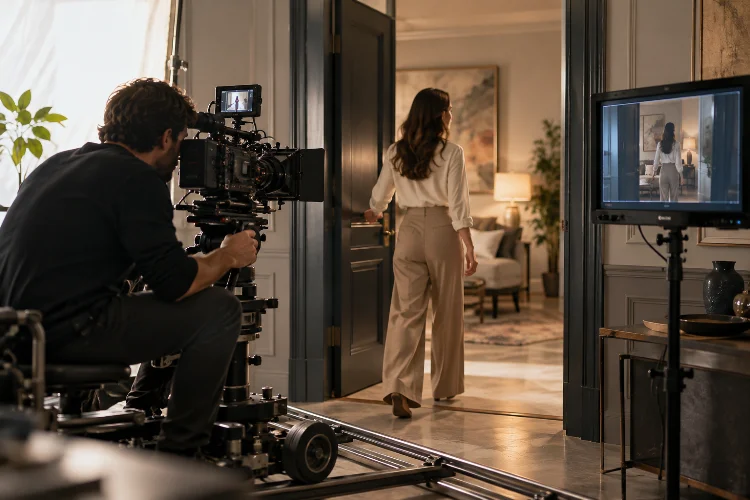
Have you ever watched an intense movie scene and completely forgotten that you’re looking at dozens of separate camera shots stitched together?
One moment, a character walks through a doorway. The next, the camera shows them entering the room from another angle. Somehow, the entire movement feels perfectly natural.
You don’t question the camera change, the location, or whether the action happened in one continuous moment.
That’s the magic of continuity editing.
While flashy transitions and dramatic visual effects often attract attention, some of cinema’s most important editing techniques are designed to remain practically invisible.
They help audiences understand where characters are, how events connect, and why certain moments matter emotionally.
More importantly, these editing decisions influence how viewers interpret the story itself.
Understanding how continuity editing shapes audience perception of movie clips reveals the hidden structure behind seemingly effortless cinematic storytelling.
In this guide, we’ll explore the fundamental principles of visual continuity, examine familiar film examples, and discover how editors guide attention, preserve spatial relationships, and create emotional connections through carefully arranged shots.
Let’s take a closer look at what makes seamless movie storytelling work.
What Is Continuity Editing in Film?
Continuity editing is a filmmaking technique that maintains consistent relationships between shots, allowing a sequence to feel like a connected, understandable series of events.
Its main purpose is to preserve the illusion of continuous space, time, and action.
Imagine filming someone making coffee.
One shot shows the person picking up a cup, another focuses on the coffee being poured, and a third captures the person taking a sip.
These moments might have been recorded separately, from different camera angles, or even during different takes.
Yet when they’re edited correctly, viewers perceive them as one natural sequence.
That’s the basic principle behind continuity filmmaking.
Spatial Continuity: Understanding Where Everything Happens
Spatial continuity helps audiences recognize the positions and relationships of characters, objects, and environments.
Consider two people sitting across from each other at a restaurant.
If one person appears on the left side of the screen, the editing should generally maintain a consistent relationship between their positions.
Otherwise, viewers might become momentarily confused about where everyone is sitting.
Spatial consistency becomes especially important during complicated action sequences involving multiple characters and moving objects.
Temporal Continuity: Making Time Feel Connected
Temporal continuity concerns the relationship between events as they unfold.
A filmmaker might record a character opening a door from several perspectives, but the resulting sequence should still appear to represent one coherent action.
This doesn’t mean every second must appear on screen.
Editors regularly remove unnecessary moments while maintaining the impression that events progress logically.
According to StudioBinder’s continuity editing guide, the technique helps filmmakers establish a believable cinematic environment by maintaining consistency across shots.
The result is storytelling that feels natural rather than mechanically assembled.
How Continuity Editing Influences Audience Perception
Good editing does much more than connect separate pieces of footage.
It influences where audiences look, which events they consider important, and how easily they understand complicated scenes.
Invisible Editing Keeps Viewers Focused
When visual transitions feel natural, audiences spend less effort trying to understand camera positions and spatial relationships.
Instead, they can concentrate on the characters, dialogue, and unfolding narrative.
This is often called invisible editing.
The term doesn’t mean viewers literally cannot see the cuts.
Rather, the transitions become so familiar and purposeful that they rarely interrupt the storytelling experience.
A dramatic conversation, for example, might contain numerous camera changes.
However, viewers primarily remember the argument, emotional reactions, and character decisions instead of the editing pattern.
The Psychology Behind Edit Blindness
There’s actually research supporting this phenomenon.
A 2008 study by Tim J. Smith and John M. Henderson, published in the Journal of Eye Movement Research, investigated how viewers perceive cuts between different camera viewpoints.
The researchers found that approximately 25% of cuts joining two viewpoints of the same scene went undetected under their experimental conditions.
That figure increased to roughly one-third when the cut coincided with the sudden onset of movement.
This phenomenon is known as edit blindness.
The findings suggest that viewers frequently remain focused on narrative information rather than consciously registering every visual transition.
However, these percentages come from a particular experiment and shouldn’t be treated as universal rates for every film or audience.
You can explore the research in Edit Blindness: The Relationship Between Attention and Global Change Blindness in Dynamic Scenes.
Continuity Helps Establish Cause and Effect
Editors also influence how audiences understand the relationship between actions and consequences.
Imagine a character looking nervously toward something outside the frame.
The next shot reveals a suspicious person approaching.
Viewers naturally interpret the second image as the source of the character’s concern.
This connection depends on editing, even though the two shots might have been filmed at completely different times.
By arranging visual information coherently, filmmakers help audiences build a mental understanding of the story.
Essential Continuity Editing Techniques Every Filmmaker Should Know
Several established techniques help editors maintain consistency between shots.
Although these principles might sound technical, most become surprisingly easy to recognize once you know what to look for.
The 180-Degree Rule
The 180-degree rule helps preserve spatial relationships between characters.
Imagine an invisible line connecting two people having a conversation.
The camera generally remains on one side of that line, allowing their relative left-right positions to remain consistent.
For example, one character might look toward screen-right while the other looks toward screen-left.
If the camera suddenly crosses the line without reorienting viewers, their positions may appear reversed.
That unexpected reversal can cause confusion.
However, the rule isn’t absolute.
As explained in StudioBinder’s guide to the 180-degree rule, directors sometimes cross the axis intentionally to communicate confusion, tension, or psychological change.
Match on Action
A match-on-action cut connects two shots by continuing the same physical movement.
Imagine someone reaching for a door handle.
The first shot shows the person beginning the movement from a wide angle.
The next captures the hand completing the action in close-up.
When the movement aligns correctly, the cut feels almost unnoticeable.
That’s because viewers are concentrating on the action rather than the transition.
This technique is particularly useful for conversations involving gestures, action sequences, and everyday physical activities.
StudioBinder’s match-on-action guide explains how cutting during movement can preserve cinematic flow.
Eyeline Matching
Eyeline matching helps viewers understand what characters are looking at.
Suppose a woman glances toward something outside the frame.
The editor cuts to a close-up of a photograph on a desk.
Audiences naturally assume the photograph is what attracted her attention.
The technique establishes a relationship between separate images while preserving spatial logic.
It’s also an effective way to communicate emotional information.
A character staring at an empty chair, for example, might suggest longing or grief when the surrounding narrative supports that interpretation.
Shot-Reverse-Shot Editing
Shot-reverse-shot is one of the most common techniques used during conversations.
The editor alternates between opposing camera angles, usually showing each character as they speak or react.
This arrangement helps audiences follow dialogue while maintaining a clear understanding of the participants’ positions.
But the technique also offers emotional flexibility.
A filmmaker might hold on one character’s face while another continues speaking.
That decision shifts attention away from the dialogue and toward the listener’s emotional response.
In other words, continuity supports clarity while leaving plenty of room for creative storytelling.
How Visual Continuity Shapes Emotional Engagement
One of the most interesting aspects of seamless editing is its effect on emotional involvement.
When viewers understand the physical and narrative relationships within a scene, they can more easily follow the characters’ experiences.
Creating Emotional Connections Through Reactions
Consider a dramatic moment when someone receives unexpected news.
The editor first shows the person delivering the information.
The next shot reveals the listener’s expression.
The camera might remain on that reaction even after the speaker continues talking.
This creates an emotional connection between the information and its psychological consequences.
Because the spatial relationship remains understandable, viewers can focus on the emotional meaning rather than figuring out who is looking at whom.
Maintaining Tension Without Confusing Viewers
Continuity becomes particularly valuable during suspenseful sequences.
Imagine a character hiding inside a house while an intruder searches nearby rooms.
The audience needs to understand where the character is hiding, where the intruder is moving, and how close the two are to encountering each other.
Editors establish these relationships through consistent screen direction, establishing shots, and carefully selected close-ups.
Once viewers understand the geography, the filmmaker can increase tension by withholding particular pieces of information.
The audience might know the intruder is approaching before the hidden character realizes it.
This difference in knowledge creates dramatic suspense.
Why Consistency Builds Narrative Trust
When a film maintains coherent visual relationships, audiences develop confidence in the world being presented.
They understand how scenes connect and can concentrate on the consequences of character decisions.
However, consistency doesn’t necessarily mean realism.
A fantasy movie can include impossible environments while still maintaining understandable relationships between shots.
What matters is whether the visual storytelling follows an internal logic that viewers can recognize.
That sense of coherence makes even extraordinary cinematic events easier to follow.
Movie Scene Examples: Continuity Editing in Action
Some of the clearest demonstrations of continuity techniques appear in familiar films.
Looking closely at individual sequences helps explain why their editing feels natural, even when the storytelling becomes intense.
Heat (1995): Spatial Clarity During a Tense Conversation
Michael Mann’s Heat contains a famous diner conversation between Vincent Hanna, played by Al Pacino, and Neil McCauley, played by Robert De Niro.
Much of the scene revolves around two characters discussing their opposing philosophies.
On paper, the setup sounds remarkably simple.
Yet the conversation feels intensely engaging.
The camera maintains a clear spatial relationship between the two men, helping viewers understand their positions throughout the exchange.
Alternating close-ups allow audiences to concentrate on facial expressions and verbal confrontation.
The scene also demonstrates how consistent eyelines support emotional storytelling.
Rather than distracting viewers with unnecessary camera movement, the visual structure emphasizes the psychological tension between the characters.
It’s an excellent example of how traditional editing techniques can make a dialogue-driven scene feel cinematic.
Mad Max: Fury Road (2015): Maintaining Clarity During Chaos
George Miller’s Mad Max: Fury Road demonstrates why spatial continuity matters during fast-paced action.
The film frequently switches between moving vehicles, physical confrontations, and dangerous environmental obstacles.
Despite the intensity, many sequences preserve recognizable movement directions and visual relationships.
Characters and vehicles often continue their actions across multiple shots.
This helps audiences follow the progression of events even when the editing becomes rapid.
The film also frequently directs attention toward important subjects near the central area of the frame.
That compositional strategy can reduce the effort required to locate key information after a cut.
The important lesson is that fast editing doesn’t automatically create confusion.
Careful continuity can support complex action while maintaining excitement.
The Shining (1980): Breaking Continuity for Psychological Unease
Stanley Kubrick’s The Shining demonstrates how deliberately breaking established visual conventions can contribute to a film’s atmosphere.
In certain conversations, changes in camera positioning challenge viewers’ expectations about spatial consistency.
Rather than always preserving a comfortable visual relationship, Kubrick sometimes introduces disorienting compositions.
These choices complement the film’s themes of psychological instability and uncertainty.
One example discussed in StudioBinder’s continuity editing analysis involves an intentional break from conventional 180-degree staging.
The shift changes the audience’s relationship with the scene.
Instead of experiencing complete visual stability, viewers encounter an unsettling transition that reinforces the film’s disturbing emotional atmosphere.
This highlights an essential principle: the most effective filmmakers understand editing rules well enough to break them with purpose.
When Breaking Continuity Becomes a Creative Advantage
Although consistent editing helps audiences follow conventional storytelling, filmmakers sometimes benefit from disrupting it.
These intentional violations are often associated with discontinuity editing.
Jump Cuts and Fragmented Time
A jump cut creates a noticeable interruption between visually similar shots.
For example, a character might appear seated in one frame and suddenly occupy a slightly different position in the next.
Without a smooth transition, viewers become aware that time or action has been removed.
Jump cuts can communicate impatience, emotional instability, or the accelerated passage of time.
They’re also common in online videos and contemporary digital storytelling.
However, their impact depends on context.
A jump cut in a casual vlog might feel energetic, while the same technique in a psychological drama could create unease.
Deliberately Disorienting the Audience
Sometimes confusion is exactly what a filmmaker wants.
Imagine a character waking up after a frightening accident.
Instead of immediately presenting a clear view of the location, the editor introduces disconnected close-ups, inconsistent viewpoints, and fragmented actions.
Viewers struggle to understand the environment, mirroring the character’s disorientation.
Eventually, the film might return to conventional spatial relationships as the character regains awareness.
The contrast makes the experience emotionally meaningful.
Knowing Which Rules to Break
Not every continuity error should be interpreted as artistic experimentation.
An accidentally changing prop or inconsistent character position may simply result from production limitations or an unnoticed mistake.
Intentional disruption, meanwhile, usually contributes to a recognizable storytelling purpose.
When analyzing a scene, ask whether breaking continuity changes what audiences understand or feel.
If the disruption serves the narrative, it may be an effective creative decision.
Practical Tips for Maintaining Continuity in Your Own Movie Clips
You don’t need a professional editing studio to practice visual continuity.
Even short videos recorded with a smartphone can demonstrate the importance of consistent camera positioning and action.
Plan the Scene Before Recording
Start by identifying where your characters will stand and how they will move.
Create a simple sketch showing their positions, camera angles, and important objects.
Establish the imaginary 180-degree line if the sequence involves interactions between multiple people.
This preparation reduces the likelihood of confusing screen direction during editing.
Record Overlapping Actions
When filming a physical movement from multiple perspectives, capture enough footage before and after the main action.
For example, if someone picks up a book, record the complete movement from the wide angle.
Then capture the same action in close-up.
During editing, choose a natural point within the movement to switch between shots.
The overlapping footage gives you flexibility when matching the action.
Check Props, Wardrobe, and Background Details
Visual consistency isn’t limited to camera position.
Objects should generally remain in logical positions unless something within the story causes them to move.
A cup that mysteriously changes hands between shots may become distracting.
Similarly, inconsistent clothing, lighting, or background details can interrupt the illusion of continuous action.
Simple continuity notes and reference photographs can help maintain consistancy throughout production.
Create Two Versions of the Same Sequence
Here’s a useful editing experiment.
Film a short conversation between two people using wide shots and close-ups.
Create one version that maintains consistent eyelines and screen direction.
Then create another version containing deliberate mismatches.
Compare how each version affects your understanding of the conversation.
You’ll likely notice that the first feels easier to follow, while the second requires more effort to interpret.
The difference becomes particularly noticable when characters move or react to objects outside the frame.
Review the Edit With Fresh Eyes
After completing your sequence, watch it without concentrating on individual cuts.
Focus instead on whether the story makes sense.
Can you identify where everyone is standing? Do actions progress naturally? Does the emotional flow remain understandable?
Then watch again, paying attention specifically to transitions.
This second viewing may reveal small inconsistencies that were easy to overlook during the initial editing process.
If possible, show the clip to someone unfamiliar with the footage.
Their reactions can reveal whether the editing communicates the intended information without additional explanation.
Common Continuity Mistakes That Affect Movie Clips
Even experienced editors occasionally encounter continuity problems.
The most common issues involve inconsistent screen direction, mismatched movement, and abrupt changes in spatial relationships.
Reversing Screen Direction
Imagine someone running from left to right across the screen.
After a cut, they’re suddenly moving right to left.
Unless the change is clearly established, viewers may assume the character has reversed direction.
This becomes especially confusing during chase sequences.
Maintaining directional consistency helps preserve the audience’s mental understanding of movement.
Mismatched Actions
Suppose someone begins sitting down in one shot.
The next angle shows them already seated before the movement is complete.
The mismatch creates an unnatural interruption.
Editors can often correct this problem by adjusting the cut point or selecting a different take.
Overlooking Emotional Continuity
Physical consistency isn’t the only consideration.
A character’s emotional response should also progress believably across shots.
If someone appears furious in one angle and completely relaxed in the next without an understandable reason, the performance may feel disconnected.
This doesn’t mean every facial expression must remain identical.
Instead, the emotional transitions should make sense within the narrative.
Sometimes an editor must choose between perfect visual matching and a stronger performance.
The best choice is generally the one that supports the audience’s understanding of the scene.
Continuity editing is one of the fundamental techniques that makes cinematic storytelling feel natural, engaging, and emotionally convincing.
By maintaining consistent relationships between shots, filmmakers help audiences understand space, follow actions, and interpret character interactions without unnecessary distractions.
Techniques such as the 180-degree rule, eyeline matching, shot-reverse-shot, and match-on-action editing create the visual foundation for coherent storytelling.
Films like Heat, Mad Max: Fury Road, and The Shining also demonstrate that continuity rules can support both clarity and intentional psychological disruption.
The key isn’t following every guideline mechanically, but understanding how editing decisions influence audience perception.
Next time you watch a memorable movie clip, examine its transitions more closely.
Better yet, try editing your own short sequence using these techniques and discover how small adjustments can completely change the viewing experience.
