
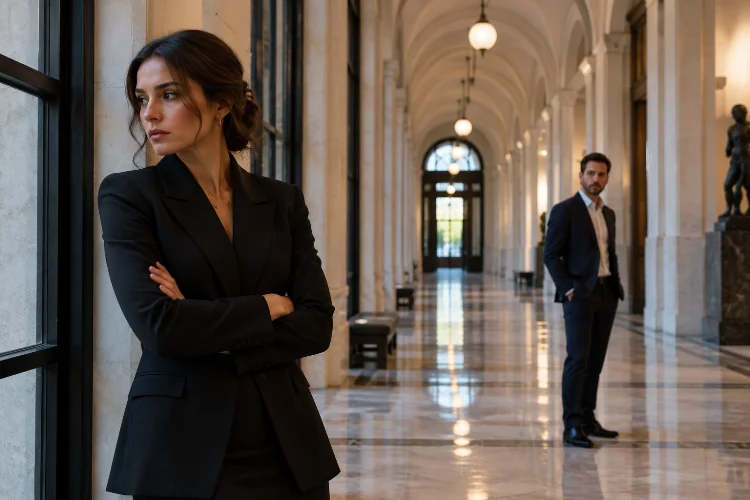
Have you ever watched a movie scene where almost nothing happens, yet somehow you can feel the tension building?
Maybe two characters are standing in a hallway, exchanging a few ordinary words. One slowly moves closer, the camera shifts slightly, and suddenly the entire conversation feels uncomfortable.
Pretty fascinating, right?
That’s the power of visual storytelling.
Filmmakers don’t always need dramatic dialogue, explosive action, or emotional music to communicate meaning. Sometimes, the position of an actor, the distance between characters, or the placement of a subject within the frame tells a much bigger story.
This is why analyzing movie clips through blocking, framing, and composition is such a valuable skill for anyone interested in cinema.
These three filmmaking techniques shape how viewers understand relationships, recognize emotional changes, and experience dramatic tension.
More importantly, they often reveal information that characters never explicitly discuss.
Whether you’re studying filmmaking, creating video essays, or simply trying to understand why certain scenes feel so powerful, learning to recognize these visual decisions can transform the way you watch movies.
Let’s explore how it all works.
1. Understanding Blocking, Framing, and Composition in Film
Before diving into complicated scene analysis, it helps to understand the differences between these three closely connected filmmaking concepts.
Although they’re frequently discussed together, each serves a slightly different storytelling purpose.
What Is Blocking in Filmmaking?
Blocking refers to the planned positioning and movement of actors within a scene.
It determines where characters stand, how they move, when they approach another person, and how they interact with the surrounding environment.
Imagine two characters having an argument in a living room.
One remains near the doorway while the other moves freely throughout the space. Without hearing their dialogue, you might already suspect that one character feels trapped while the other controls the situation.
That’s blocking communicating narrative information through physical behavior.
Understanding Camera Framing
Framing describes how subjects and visual elements are positioned within the camera’s field of view.
A character might appear in the center, near the edge, partially hidden behind another object, or surrounded by empty space.
These choices influence what viewers notice and how they emotionally interpret the image.
For example, a close-up that isolates a nervous character creates a different experience from a wide shot showing that same character standing alone in an enormous room.
What Makes Composition Different?
Composition concerns the overall arrangement of visual elements within an image.
It involves balance, symmetry, depth, visual weight, leading lines, and the relationship between positive and negative space.
While framing establishes what appears onscreen, composition examines how those elements work together visually.
Think of it this way: blocking arranges the performers, framing determines what the camera includes, and composition organizes the visual experience.
When these techniques support one another, even an ordinary scene can communicate surprisingly complex ideas.
2. How Actor Blocking Reveals Character Relationships
One of the most interesting things about film blocking is that it can communicate power, attraction, conflict, and vulnerability without requiring explanatory dialogue.
A character’s physical position often becomes part of their emotional identity within a scene.
Physical Distance as Emotional Distance
Pay attention to how far characters stand from one another.
People who feel emotionally connected might naturally occupy the same visual space, while characters experiencing tension may remain separated by furniture, doorways, or other obstacles.
However, physical closeness doesn’t always mean emotional intimacy.
Two characters standing extremely close during an argument might create feelings of aggression or intimidation rather than affection.
The meaning depends on the larger dramatic context.
For instance, imagine a couple sitting at opposite ends of a long dining table after an argument. The distance visually emphasizes their emotional seperation, even if their conversation remains polite.
That visual arrangement can communicate more than an additional page of dialogue.
Movement Can Change Power Dynamics
Blocking becomes especially interesting when characters change positions during a scene.
Someone who begins a conversation seated might eventually stand, move across the room, and confront another character directly.
This physical transition may reflect a change in confidence, authority, or emotional control.
In Francis Ford Coppola’s The Godfather (1972), carefully controlled staging and character movement contribute to the film’s examination of family loyalty, authority, and Michael Corleone’s transformation.
The characters’ relationships are expressed through positioning and behavior as well as dialogue.
A useful technique is to track who controls the physical space at the beginning of a scene and who controls it by the end.
If the arrangement changes, ask what dramatic shift accompanies that movement.
Blocking Creates Visual Subtext
Subtext refers to meaning communicated beneath the surface of spoken words or visible actions.
A character might say they’re comfortable while repeatedly moving away from someone.
Another might appear confident but avoid direct physical confrontation.
These contradictions reveal emotional information that dialogue alone might conceal.
When analyzing movie clips, focus on the moments when body language and physical positioning communicate something different from what characters say.
Those moments often contain the richest material for interpretation.
3. Analyzing Camera Framing and Audience Perspective
Camera framing plays a major role in deciding how close viewers feel to characters and how much information they receive.
Directors can guide emotional attention by changing shot sizes, camera perspectives, and the placement of subjects.
Wide Shots, Medium Shots, and Close-Ups
Wide shots establish the environment and show how characters relate to the surrounding space.
They can communicate isolation, vulnerability, freedom, or overwhelming scale.
Medium shots provide a balance between facial expressions and physical behavior. They’re especially useful when analyzing conversations and relationships.
Close-ups emphasize details that might otherwise disappear.
A subtle expression, a trembling hand, or an uncomfortable glance can become dramatically important when the camera draws attention to it.
However, no shot size has one automatic meaning.
A close-up can feel intimate in a romantic scene but threatening during an interrogation.
That’s why effective film clip analysis always connects camera choices to narrative context.
Over-the-Shoulder Framing and Perspective
Over-the-shoulder shots are particularly common in dialogue scenes.
By placing part of one character’s body in the foreground while showing another character beyond it, filmmakers establish spatial relationships and conversational perspective.
This framing can create a sense of connection between characters.
However, changing the size or prominence of the foreground figure can also influence perceived dominance.
Imagine an intimidating character occupying a large portion of the foreground while another appears small in the distance.
The composition might suggest pressure or vulnerability, depending on the performances and situation.
Framing Within the Frame
Sometimes, filmmakers use windows, mirrors, corridors, or doorways to create additional frames inside the main image.
This technique can emphasize confinement, emotional distance, secrecy, or separation.
In In the Mood for Love (2000), director Wong Kar-wai frequently places characters within restricted architectural spaces.
Doorways, corridors, and partially obstructed views reinforce the emotional limitations surrounding the central relationship.
The framing doesn’t simply make the film visually elegant.
It helps viewers experience the characters’ sense of longing and restraint.
4. Understanding Visual Composition and Cinematic Balance
Composition is where filmmaking starts to resemble painting, photography, and visual design.
Every object inside the frame influences how the image feels, even when viewers aren’t consciously examining its arrangement.
The Rule of Thirds in Movie Composition
The rule of thirds divides an image into nine sections using two horizontal and two vertical lines.
Filmmakers sometimes place important subjects near the intersections to create a visually engaging arrangement.
For instance, positioning a character along one vertical third can leave space for the surrounding environment.
That empty area might establish context, suggest anticipation, or emphasize emotional isolation.
But the rule of thirds isn’t a requirement for every successful image.
Directors frequently ignore it when centered framing, unusual visual imbalance, or more complex arrangements better support the story.
The important question isn’t whether a scene follows a compositional guideline.
It’s whether the arrangement contributes to the intended dramatic effect.
Symmetry and Asymmetry
Symmetrical compositions distribute visual elements around a central axis.
They can suggest order, precision, stability, or artificial control.
Wes Anderson is widely associated with carefully arranged symmetrical imagery, although symmetry is only one part of his distinctive visual approach.
Asymmetrical compositions distribute visual weight unevenly.
This imbalance can create movement, tension, uncertainty, or an expectation that something will change.
Neither approach is automatically better.
A balanced composition can feel deeply unsettling in the right context, while an uneven image can appear relaxed and completely natural.
Negative Space and Isolation
Negative space refers to the relatively empty areas surrounding the main subject.
It’s particularly effective when filmmakers want viewers to notice isolation or anticipate something entering the frame.
Imagine a frightened character standing on the far left of a wide image while the right side remains completely empty.
The audience might begin searching that empty area for a potential threat.
In this situation, the space itself becomes part of the suspense.
Negative space also helps communicate scale, emphasize visual simplicity, and direct attention toward important subjects.
Leading Lines and Visual Attention
Leading lines are visible or implied lines that guide attention through a composition.
Roads, hallways, staircases, architectural edges, and patterns can direct the viewer’s eye toward a character or significant object.
A corridor stretching toward a distant doorway might emphasize the importance of whatever waits at its end.
Similarly, converging architectural lines can make a character appear trapped within a carefully controlled environment.
When studying composition, ask where your eyes naturally travel first and what visual elements encourage that movement.
5. Exploring Depth, Camera Movement, and Spatial Continuity
Great visual storytelling isn’t limited to arranging subjects across a flat screen.
Filmmakers also use foreground, middle ground, background, and camera movement to create meaningful relationships within three-dimensional space.
Foreground and Background Storytelling
Depth allows filmmakers to communicate multiple pieces of information simultaneously.
An important conversation might happen in the foreground while another character reacts silently in the background.
The audience can observe both interactions without requiring an additional cut.
This approach can introduce dramatic irony because viewers notice information that the foreground characters may overlook.
Deep-focus cinematography can make different layers of the scene appear relatively sharp, encouraging viewers to explore their relationships.
However, shallow focus can be equally expressive.
By keeping one subject sharp while the surroundings become blurred, filmmakers can isolate attention or reflect a character’s limited awareness.
Camera Movement Changes Spatial Relationships
Blocking and camera movement frequently work together.
A tracking shot might follow a character across a room while revealing new information about the environment.
A slow camera push can make a previously ordinary interaction feel increasingly intimate or threatening.
The meaning comes from the relationship between the movement and the dramatic situation.
For example, a camera that gradually approaches two arguing characters may reduce the visible environment, concentrating attention on their emotional confrontation.
A moving shot might also reveal that someone previously outside the frame has been observing the interaction.
In that case, camera movement actively changes what the audience knows.
The 180-Degree Rule and Screen Direction
Spatial continuity helps viewers understand where characters are positioned relative to one another.
The 180-degree rule uses an imaginary line between subjects to maintain consistent left-right relationships across camera angles.
When filmmakers remain on one side of that line, shot transitions are usually easier to follow.
Crossing the line can create disorientation, although directors sometimes do it delibrately to reflect confusion or a change in perspective.
When analyzing a scene, observe whether camera positions maintain stable geography or make the audience reconsider the space.
An apparent violation becomes more interesting when it supports a recognizable narrative purpose.
6. Real Movie Examples: How Visual Construction Creates Meaning
Theory becomes much easier to understand when you connect it with actual films.
Several celebrated directors demonstrate how visual construction can communicate complicated themes through seemingly simple arrangements.
Parasite: Architecture and Social Hierarchy
Bong Joon-ho’s Parasite (2019) offers an excellent example of how composition and spatial design reinforce narrative themes.
The film contrasts the wealthy Park family’s spacious residence with the Kim family’s cramped semi-basement apartment.
Stairs, levels, windows, and architectural boundaries repeatedly emphasize differences in social position.
Characters physically move between these environments, transforming their journeys into visual expressions of economic inequality.
The Park residence also contains carefully organized sightlines and hiding places.
During moments when the Kim family must conceal their presence, the building’s layout becomes central to the suspense.
Instead of merely illustrating the story’s setting, the architecture actively shapes its conflicts.
In the Mood for Love: Framing Emotional Restraint
Wong Kar-wai’s In the Mood for Love demonstrates how visual restriction can reinforce emotional complexity.
The central characters develop a connection that remains constrained by social expectations and personal decisions.
Narrow corridors, doorframes, and obstructed compositions repeatedly limit how freely they appear within the image.
Their physical environment reflects their emotional circumstances.
The film also uses repeated movements and carefully staged encounters to create a feeling of routine and longing.
By observing these patterns, viewers can recognize how the visual language develops alongside the relationship.
A Simple Scene Comparison
Imagine two directors filming the same conversation between a parent and an adult child.
The first director places both characters in a balanced two-shot, allowing their expressions and body language to unfold together.
The second isolates each person in seperate close-ups, using furniture and architectural elements to suggest division.
Both versions could communicate the same factual information.
However, the emotional experience would likely be different because each arrangement encourages viewers to interpret the relationship differently.
This hypothetical example illustrates an important lesson: cinematic meaning depends not only on what occurs but also on how filmmakers present it.
7. A Practical Method for Analyzing Movie Clips Step by Step
Understanding individual techniques is useful, but combining them into a consistent analytical process produces much stronger results.
You can practice this approach with almost any film, regardless of genre, budget, or production style.
Start With the Scene’s Dramatic Purpose
Choose a clip lasting approximately two to four minutes.
Watch it once without pausing and identify the characters, their immediate goals, and the conflict shaping their interaction.
Then ask what changes between the beginning and ending.
Perhaps a character gains confidence, discovers information, loses authority, or decides to abandon a relationship.
This dramatic change provides a useful foundation for investigating visual choices.
Create a Basic Blocking Map
Watch the scene again and pay attention only to actor movement.
Notice where each character begins, when they move, and how the distance between them changes.
For more detailed analysis, sketch a simple overhead diagram of the room.
Mark the positions of characters, furniture, doors, and important objects.
You might discover that a character repeatedly retreats toward an exit or that another gradually dominates the available space.
These movement patterns can help explain the scene’s emotional progression.
Examine Individual Frames
Pause at several important moments and study the visual arrangement.
Identify shot size, subject position, negative space, leading lines, depth, and foreground elements.
Compare compositions before and after significant narrative developments.
For example, does a character initially share the frame with another person but appear alone after an argument?
Does the camera move closer as the confrontation becomes more intense?
Observing these differences helps connect visual design with storytelling.
Connect Visual Decisions to Narrative Meaning
Avoid stopping at descriptions such as “the scene uses a close-up” or “the composition is symmetrical.”
Those observations are useful starting points, but they don’t explain why the techniques matter.
Instead, connect each observation to a possible emotional or dramatic effect.
A stronger interpretation might explain that an increasingly restrictive composition reinforces a character’s growing lack of control.
Support that interpretation with multiple moments from the clip.
If the same visual pattern appears throughout the scene, your explanation becomes more convincing.
Compare Your Findings Across Scenes
Once you’ve analyzed one sequence, compare it with another scene from the same film.
Look for recurring patterns in actor placement, camera angles, and visual organization.
You might notice that a director consistently places a particular character behind barriers or uses centered compositions during moments of emotional control.
Repeated visual choices can reveal broader themes and directorial preferences.
However, avoid treating every technical decision as symbolic.
Sometimes camera placement is influenced by geography, production limitations, or continuity requirements.
The strongest film analysis distinguishes observable evidence from personal interpretation.
Analyzing movie clips through blocking, framing, and composition reveals how much storytelling happens without words.
Actor movement communicates relationships and power dynamics, camera framing shapes audience perspective, and visual composition directs attention while reinforcing emotion.
Together, these techniques transform ordinary interactions into meaningful cinematic experiences.
The key is to look beyond beautiful images and examine how visual choices support character development, dramatic conflict, and narrative themes.
You don’t need advanced filmmaking equipment to begin. A favorite movie, a notebook, and the ability to replay individual scenes are enough.
Ready to improve your film analysis skills?
Choose a memorable movie clip today, examine the characters’ positions and camera framing, and explore how each visual decision influences the story.
You might never watch movies the same way again.
