
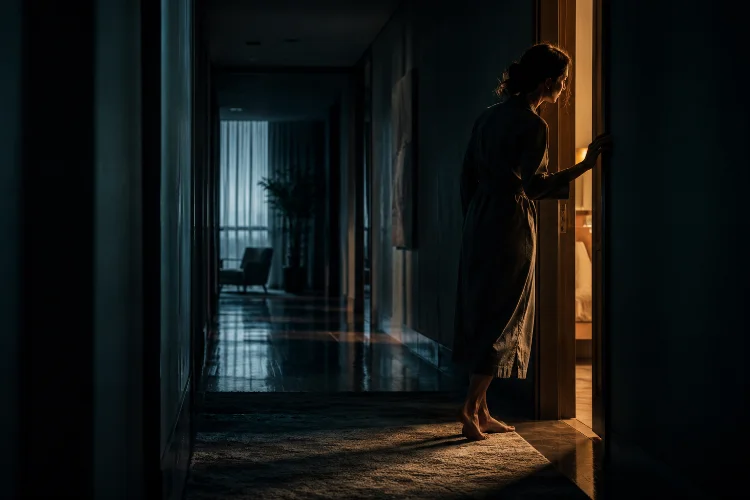
Think about the last movie scene that made you lean forward, hold your breath, or feel strangely uncomfortable without really knowing why.
Maybe it was a character walking into a dark hallway. Perhaps it was an ordinary conversation where something felt terribly wrong. Or maybe it was a single close-up that revealed more emotion than an entire page of dialogue.
That’s the fascinating thing about iconic movie scenes. They don’t always need explosions, dramatic confrontations, or complicated action sequences to make audiences feel something powerful.
Instead, great filmmakers carefully combine visual storytelling, emotional stakes, cinematography, editing, and sound to create tension that feels almost impossible to escape.
Understanding how iconic movie scenes establish emotional and visual tension gives us a deeper appreciation of cinema. It also reveals why certain moments remain unforgettable decades after their original release.
In this guide, we’ll explore the filmmaking techniques behind memorable cinematic moments, examine famous examples, and discover how directors transform seemingly ordinary situations into extraordinary storytelling experiences.
1. Understanding Emotional and Visual Tension in Cinema
Before exploring famous movie sequences, it’s important to understand what cinematic tension actually means.
At its simplest, tension develops when audiences anticipate something significant but don’t know exactly how events will unfold. That uncertainty creates psychological pressure, encouraging viewers to pay closer attention.
However, emotional tension and visual tension work in slightly different ways.
Emotional Tension: Making Audiences Care
Emotional tension comes from a character’s desires, fears, relationships, and personal conflicts.
Imagine watching someone prepare to confess a painful secret to their closest friend. Nothing physically dangerous is happening, yet the possibility of rejection creates genuine anxiety.
The audience becomes emotionally invested because the outcome matters to the character.
This is why effective character development is so important. When viewers understand what someone stands to lose, even a quiet conversation can feel incredibly intense.
Emotional stakes also extend beyond immediate danger. Shame, betrayal, heartbreak, ambition, and uncertainty can generate suspense just as effectively as physical threats.
Visual Tension: Making Audiences Feel Uneasy
Visual tension emerges from how filmmakers organize images on the screen.
Unusual camera angles, unsettling compositions, restricted visibility, dramatic lighting, and carefully controlled movement can create discomfort before anything threatening actually happens.
For example, placing a character near the edge of the frame while leaving a large, empty space behind them might suggest that something could appear unexpectedly.
Nothing needs to happen immediately. The composition itself encourages viewers to anticipate danger.
The strongest cinematic sequences combine these two elements, using visual information to reinforce emotional consequences.
That’s when movie storytelling becomes especially powerful.
2. Character Stakes and Suspense: Why We Care About What Happens
One of the biggest secrets behind memorable cinematic moments is surprisingly simple: audiences need a reason to care.
A technically impressive scene might look beautiful, but visual sophistication alone rarely produces lasting emotional engagement.
The audience needs to understand what the character wants, what prevents them from achieving it, and what happens if they fail.
Rear Window: Building Suspense Through Limited Control
Alfred Hitchcock’s Rear Window (1954) remains one of cinema’s clearest examples of emotional suspense.
The story follows photographer L.B. Jeffries, who observes his neighbors while recovering from a broken leg. What begins as harmless curiosity gradually becomes an investigation into a possible murder.
The film creates tension through a fascinating limitation: Jeffries can see potential danger but cannot easily intervene.
When his girlfriend Lisa enters a suspected murderer’s apartment, the emotional stakes increase dramatically.
Jeffries watches from across the courtyard, unable to physically protect her if something goes wrong.
Hitchcock transforms the distance between two apartments into a psychological obstacle.
The audience shares Jeffries’ restricted perspective, making every unexpected movement and potential discovery feel increasingly threatening.
The British Film Institute highlights the film’s exploration of voyeurism, emphasizing how its windows function like individual screens filled with stories and uncertainty.
The Power of Dramatic Irony
Another technique involves giving viewers information that certain characters don’t possess.
This is called dramatic irony, and it’s especially effective in suspense filmmaking.
Imagine seeing an intruder hiding inside a house before the unsuspecting homeowner arrives.
Every ordinary action suddenly becomes meaningful. Opening a refrigerator, answering a telephone, or walking upstairs creates anxiety because we understand the hidden danger.
The filmmaker isn’t simply showing us what happens.
They’re controlling what we know, what characters know, and how long we must wait for those perspectives to collide.
Practical insight: Before analyzing any dramatic scene, ask what the audience fears losing. The clearer the emotional consequences, the more meaningful the suspense becomes.
3. Framing, Composition, and Blocking Create Invisible Power Struggles
Have you ever noticed how two characters sitting across a table can somehow make an entire room feel threatening?
That’s often the result of thoughtful cinematic composition.
Directors use framing, spatial relationships, and actor positioning to communicate authority, vulnerability, and emotional distance without explaining everything through dialogue.
The Godfather: Power Hidden Inside the Frame
Francis Ford Coppola’s The Godfather (1972) offers exceptional examples of visual storytelling.
Consider the family discussion in which Michael Corleone gradually establishes himself as someone capable of making serious decisions.
At first, Michael appears less dominant than the other powerful personalities surrounding him.
As the conversation develops, the blocking, camera attention, and performances increasingly emphasize his importance.
A subtle change in framing reflects a much larger transformation in character authority.
StudioBinder’s scene analysis examines how actor positioning and camera movement guide viewers toward Michael as the conversation’s center of attention.
This reveals an essential filmmaking principle: the arrangement of people within a shot can communicate who controls a situation.
Negative Space and Psychological Discomfort
Negative space refers to relatively empty areas surrounding a subject within the frame.
Filmmakers frequently use it to generate isolation, anticipation, or vulnerability.
A character positioned alone inside a large room might appear emotionally disconnected. The same character framed beside an empty doorway might suggest an unseen presence.
These visual relationships can influence audiences subconciously, even when viewers aren’t actively studying the cinematography.
Depth also matters.
A threatening figure standing quietly in the background can create more discomfort than an aggressive close-up, particularly when the protagonist remains unaware of their presence.
Blocking becomes especially expressive when characters move closer together, turn away, or cross physical boundaries.
Distance might represent distrust, while a sudden movement into another person’s personal space can suggest intimidation.
Practical insight: Pause a memorable movie scene and examine where every major character appears within the frame. Then consider how those positions communicate relationships before anyone speaks.
4. Camera Angles and Movement Turn Ordinary Moments Into Anxiety
Camera movement isn’t simply about making films look dynamic.
It’s also a powerful way to influence how viewers experience space, uncertainty, and emotional instability.
A slowly approaching camera might suggest an approaching realization. A distant wide shot can expose how vulnerable someone appears within a threatening environment.
Even the decision to keep the camera completely still can create uncomfortable anticipation.
Jaws: When Perspective Becomes Panic
Steven Spielberg’s Jaws (1975) demonstrates how camera techniques can communicate a character’s psychological experience.
During the famous beach sequence, Police Chief Martin Brody witnesses a shark attack.
Spielberg employs a technique commonly known as the dolly zoom.
The camera moves while the lens zooms in the opposite direction, creating an unsettling change in the relationship between Brody and the background.
Brody remains relatively consistent in size, but the surrounding environment seems to shift dramatically.
The result is a visual representation of sudden horror and realization.
The American Society of Cinematographers discusses this technique in its article about camera movement, connecting the effect to earlier work in Hitchcock’s Vertigo.
What’s especially effective about the Jaws sequence is how its camera movement connects an external event to an internal emotional response.
We don’t simply witness the attack. We experience something resembling Brody’s shock.
Controlling What the Audience Can See
Camera perspective also determines what remains hidden.
A subjective point-of-view shot can restrict viewers to the information available to a particular character.
Meanwhile, a wide shot might reveal environmental details that suggest approaching danger.
Filmmakers can alternate between these perspectives to manipulate uncertainty.
An unpredicatable change in viewpoint can increase anxiety, especially when the audience expects the camera to reveal something important.
However, movement shouldn’t become distracting.
The most effective camera techniques serve a character’s emotional experience rather than existing purely as visual decoration.
5. Lighting, Color, and Production Design Shape Psychological Atmosphere
Lighting can completely transform how audiences interpret an ordinary location.
A brightly illuminated kitchen might communicate safety and familiarity. Introduce deep shadows, uneven lighting, and restricted visibility, and that same kitchen could suddenly feel threatening.
But effective visual tension isn’t simply about making everything darker.
It’s about shaping the relationship between what audiences can see and what remains uncertain.
The Godfather: Darkness as a Storytelling Language
The cinematography of The Godfather, developed by Gordon Willis, demonstrates how shadow can communicate emotional complexity.
Dark interiors, warm tones, and controlled lighting create an atmosphere associated with secrecy, authority, and moral ambiguity.
Characters sometimes appear with heavily shadowed eyes, making their intentions difficult to interpret.
This visual approach supports a story in which personal loyalty and ruthless decision-making repeatedly overlap.
Willis’ influential lighting style is discussed in a retrospective published by British Cinematographer, including its unusual combination of darkness and warm color.
Rather than explaining every emotional detail directly, the film allows visual atmosphere to contribute to character interpretation.
Parasite: Architecture as Emotional Conflict
Bong Joon-ho’s Parasite (2019) offers another fascinating example of production design supporting visual meaning.
The film repeatedly emphasizes the physical differences between elevated living spaces and lower, more confined environments.
Staircases, windows, building layouts, and underground spaces become visual expressions of social inequality.
As characters move between these environments, their physical journeys also reinforce the story’s emotional and social conflicts.
The architecture becomes more than a backdrop.
It helps audiences understand the tensions between social classes without requiring constant verbal explanation.
This is why location design matters so much in modern cinematography.
Doors, corridors, reflections, furniture, and even ceiling height can contribute to the emotional character of a scene.
Color works similarly, although its meaning depends on context.
Red might suggest danger in one film but represent romance, identity, or celebration in another.
Strong filmmakers establish visual associations delibrately, then use those associations to support changing narrative circumstances.
6. Editing and Pacing Control How Long Audiences Feel Suspense
Sometimes the most emotionally powerful decision in a movie happens after filming is finished.
Editing determines when viewers receive information, how long they experience uncertainty, and which emotional reactions deserve attention.
A single sequence can feel peaceful, terrifying, or heartbreaking depending on how its shots are arranged.
Psycho: The Psychological Impact of Rapid Editing
Hitchcock’s Psycho (1960) features one of the most recognizable editing sequences in film history.
The famous shower scene begins with an apparently private, peaceful moment.
That sense of normality makes the sudden attack especially disturbing.
The sequence uses fragmented images, abrupt changes in perspective, sharp sound, and rapid cutting to produce an overwhelming sense of violence.
Importantly, the audience doesn’t need to see every physical detail to understand the horror.
Editing encourages viewers to mentally connect individual images, creating an experience that feels more explicit than much of what is actually visible.
The sequence demonstrates how strongly perception depends on the relationship between shots.
An extended moment of calm establishes an expectation. The sudden acceleration of cutting disrupts that expectation, creating intense emotional shock.
The Godfather: Tension Through Parallel Editing
Another celebrated example occurs during the baptism sequence in The Godfather.
The film moves between a religious ceremony and violent acts carried out under Michael Corleone’s authority.
These contrasting events create a powerful moral contradiction.
Michael publicly participates in a sacred ritual while his criminal power is being consolidated through violence.
The editing encourages viewers to interpret the events together, revealing a disturbing relationship between appearance and reality.
Parallel editing can also create urgency when multiple characters face simultaneous danger.
The audience becomes invested in several unresolved situations, increasing the complexity of the suspense.
Why Slower Editing Can Be Just as Effective
Fast cutting isn’t always the strongest approach.
A lengthy shot can force viewers to remain inside an uncomfortable moment, unable to escape through a change in perspective.
StudioBinder’s discussion of editing rhythm explains how shot duration influences a film’s emotional pace.
Holding a reaction shot longer than expected can make a character’s hesitation feel significant.
Similarly, delaying a cut might cause viewers to search the frame for clues.
This creates a useful contrast: rapid editing can communicate chaos, while sustained framing can intensify anticipation.
The key isn’t choosing fast or slow editing.
It’s understanding what emotional response each rhythm creates.
7. Sound Design, Silence, and the Art of Sustaining Tension
Visual storytelling receives plenty of attention, but sound is equally important in creating memorable cinematic experiences.
A scene’s atmosphere can change dramatically depending on the presence of music, environmental noise, dialogue, or silence.
Sometimes the smallest sound becomes the most disturbing element.
No Country for Old Men: Making Ordinary Sounds Threatening
The Coen brothers’ No Country for Old Men (2007) uses restrained sound design to create extraordinary suspense.
Consider the famous gas station conversation between Anton Chigurh and the proprietor.
On the surface, the exchange appears relatively ordinary.
Yet Chigurh’s unsettling questions, prolonged pauses, and unpredictable behavior gradually transform the interaction into a threatening encounter.
The tension develops because viewers recognize the possibility of violence while the conversation continues to resemble an everyday interaction.
Instead of relying on an aggressively dramatic musical score, the scene allows dialogue, performance, and ordinary environmental sounds to carry the discomfort.
This approach makes the moment feel intimate and disturbingly believable.
The smallest hesitation becomes meaningful.
Even the sound of a coin can acquire enormous narrative importance.
How Silence Changes the Audience’s Expectations
Silence can be especially powerful when filmmakers establish an expectation of sound and then remove it.
Think about a character entering an unfamiliar building after hearing strange noises.
If those noises suddenly stop, the environment may feel even more threatening.
The absence of sound creates a question: what caused everything to become quiet?
Sound designers also manipulate volume, distance, and texture to direct attention.
A distant footstep might suggest approaching danger, while exaggerated breathing can make viewers aware of a character’s physical vulnerability.
StudioBinder’s exploration of suspense techniques examines how environmental sounds and carefully controlled music help audiences experience threats beyond the visible frame.
How to Analyze Tension in Any Movie Scene
Understanding these techniques becomes easier when you actively examine a sequence rather than watching only for entertainment.
Start by identifying the central emotional conflict. Determine what the protagonist wants, what stands in the way, and what information the audience possesses.
Next, observe the visual arrangement.
Pay attention to character placement, empty spaces, camera distance, lighting contrasts, and environmental details. Ask whether these elements communicate control, vulnerability, uncertainty, or hidden danger.
Then examine how the sequence changes over time.
Does the camera move closer? Do the cuts become faster? Does the soundtrack become quieter, louder, or more irregular?
Finally, consider the emotional payoff.
A successful scene often transforms the tension it establishes into relief, surprise, tragedy, or a meaningful change in character.
For filmmakers and video creators, this process offers a practical method for improving visual storytelling.
For movie enthusiasts, it’s an intresting way to discover artistic decisions that might otherwise go unnoticed.
The goal isn’t to identify as many cinematic techniques as possible.
It’s to understand how individual filmmaking choices work together to shape the audience’s emotional experience.
Iconic movie scenes become unforgettable because they create meaningful connections between visual storytelling and human emotion.
Through carefully developed character stakes, purposeful framing, expressive lighting, strategic camera movement, rhythmic editing, and immersive sound design, filmmakers transform ordinary moments into powerful cinematic experiences.
From Hitchcock’s masterful suspense to the atmospheric cinematography of The Godfather and the unsettling silence of No Country for Old Men, these examples demonstrate that tension depends on far more than dramatic action.
Ultimately, the strongest scenes make audiences feel something before they fully understand why.
Next time you watch a favorite film, revisit one memorable sequence and examine how its visual and emotional elements work together.
You might discover an entirely new appreciation for the craft behind the movies you love.
