
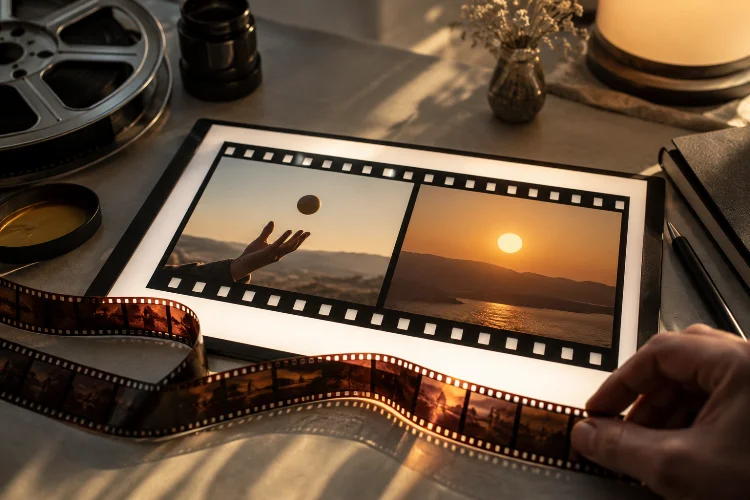
Have you ever watched a movie where one scene transitions into another so perfectly that you barely notice the edit?
Maybe a character throws an object into the air, and suddenly that object becomes something completely different in the next shot. Or perhaps a close-up of someone’s eye transforms into a visually similar image from another location.
Pretty clever, right?
These moments aren’t simply editing tricks designed to impress audiences. They’re carefully constructed storytelling decisions that connect images, ideas, emotions, and sometimes entirely different periods of time.
That’s exactly what makes understanding match cuts and visual transitions in film scenes so interesting.
Great filmmakers know that the space between two shots can communicate just as much meaning as the shots themselves.
A well-designed transition can introduce a new setting, reveal an emotional connection, highlight a symbolic relationship, or move the story forward without requiring additional dialogue.
Whether you’re an aspiring filmmaker, video editor, film student, or casual movie enthusiast, learning how these techniques work can completely change how you experience cinematic storytelling.
Let’s explore the creative thinking behind some of cinema’s most memorable transitions.
1. Why Visual Transitions Matter in Cinematic Storytelling
When people think about film editing, they often imagine someone arranging clips on a timeline and removing unnecessary footage.
And technically, that’s part of the process.
However, professional film editing involves much more than deciding when one shot should end and another should begin.
It’s about shaping how audiences experience time, space, emotion, and narrative information.
Editing Creates Connections Between Images
Imagine watching a close-up of a spinning ceiling fan.
The next shot shows the rotating blades of a helicopter.
Although the objects belong to completely different environments, their shared circular movement creates a visual connection.
Viewers can recognize the relationship almost instantly.
This is one of the fundamental ideas behind visual editing: two separate images can produce additional meaning when placed together.
The connection might be purely aesthetic, but it can also communicate a deeper narrative idea.
For example, the transition could suggest a change in location, a memory association, or the continuation of movement across seperate environments.
Transitions Influence Emotional Rhythm
Film transitions also determine how quickly audiences move between dramatic situations.
A sudden hard cut can create surprise, urgency, or emotional contrast.
A gradual dissolve might suggest reflection, nostalgia, or the passage of time.
Meanwhile, a carefully coordinated match cut can create an unexpected sense of continuity between unrelated images.
These choices influence the emotional rhythm of a movie.
Consider a dramatic scene ending with complete silence, followed immediately by a crowded celebration.
That abrupt contrast might feel shocking, humorous, or deeply ironic.
A different transition could completely change the emotional experience.
This is why analyzing scene transitions requires looking beyond the technical effect and considering its relationship with the story.
2. What Is a Match Cut? Understanding the Main Types
A match cut is an editing technique that connects two shots through a recognizable similarity.
That similarity might involve shape, movement, composition, color, or another visual characteristic.
The goal is to establish continuity or create a meaningful relationship between otherwise separate images.
Unlike an ordinary cut, a match cut encourages viewers to notice something the two shots share.
Graphic Match Cuts: Connecting Shapes and Composition
A graphic match cut connects images through visual similarities.
For example, a circular clock might transition into a similarly positioned full moon.
The objects are unrelated in a literal sense, but their shared shape makes the edit feel connected.
Graphic matching can involve several visual elements, including color, size, orientation, camera framing, and the position of subjects within the frame.
A director might transition from a character standing in the center of a doorway to another character occupying an identically framed entrance.
This repetition can establish a thematic connection between the two situations.
The technique becomes especially effective when the visual similarity reinforces the film’s central ideas.
Match on Action: Maintaining Movement
A match on action cut connects shots by continuing a movement across an edit.
Imagine a character reaching for a door handle in a medium shot.
The editor cuts to a close-up while the hand continues the same action.
Because the movement remains consistent, the transition feels natural and continuous.
This technique is commonly used in dialogue scenes, action sequences, and everyday character interactions.
However, matching action doesn’t always require both shots to occur in the same location.
A filmmaker could show someone jumping into a swimming pool and then cut to the same character landing on a bed.
The physical motion creates continuity even though the environment changes dramatically.
It’s a creative way to compress time while preserving visual momentum.
Audio Matches and Sound Bridges
Not every meaningful transition depends entirely on imagery.
A sound bridge connects scenes through audio that begins before or continues after a visual cut.
For instance, the sound of a ringing telephone might begin while the previous scene is still visible.
When the picture changes, viewers discover the telephone belongs to the next location.
A closely matched sound can also link two unrelated actions.
Although sound bridges aren’t necessarily visual match cuts, they’re important companions to image-based transitions.
They demonstrate how editing can coordinate sight and sound to produce smooth narrative progression.
3. Famous Match Cut Examples That Changed Film Storytelling
Some of cinema’s most memorable editing moments demonstrate how simple visual relationships can communicate complicated ideas.
These examples show why match cutting remains such an influential technique.
2001: A Space Odyssey – A Journey Across Time
One of the most celebrated examples appears in Stanley Kubrick’s 2001: A Space Odyssey (1968).
During the film’s prehistoric sequence, an early human ancestor throws a bone into the air.
As the bone rotates, the film suddenly cuts to a spacecraft moving through space.
The transition connects two radically different periods of human development.
What makes the moment extraordinary isn’t simply the similarity between the rotating objects.
It’s the enormous amount of narrative information communicated through a single edit.
The bone represents an early tool, while the spacecraft evokes advanced technological development.
In a matter of seconds, the film visually connects humanity’s primitive beginnings with its technological future.
The cut invites viewers to consider the relationship between tools, progress, power, and human evolution.
No explanatory dialogue is necessary.
Lawrence of Arabia – From Flame to Sunrise
David Lean’s Lawrence of Arabia (1962) offers another iconic example.
T. E. Lawrence extinguishes a burning match, and the film cuts to a magnificent sunrise over the desert.
The transition connects the brightness of the small flame with the expansive light of the rising sun.
It’s visually elegant, but its effectiveness comes from more than matching colors.
The edit also introduces a dramatic change in scale.
A tiny, controlled source of light gives way to a vast natural landscape.
The contrast creates a sense of anticipation while establishing the grandeur of the desert environment.
It’s a great example of how a simple cut can feel more impressive than an elaborate digital effect.
Psycho – The Shower Drain and Marion’s Eye
Alfred Hitchcock’s Psycho (1960) features a famous visual transition following the shower murder.
The camera focuses on water swirling into the drain before dissolving into an image of Marion Crane’s eye.
The circular forms establish a striking graphic relationship.
However, unlike a straightforward hard match cut, this transition uses a dissolve.
That distinction matters when analyzing editing techniques.
The visual connection invites viewers to associate the draining water with Marion’s death.
By combining related shapes with a gradual transition, Hitchcock creates a poetic and disturbing visual metaphor.
The moment demonstrates that graphic matching can work through different editing methods, not just instantaneous cuts.
The Graduate – Connecting Disconnected Experiences
Mike Nichols’s The Graduate (1967) uses movement-based transitions to express Benjamin Braddock’s emotional disorientation.
In one memorable sequence, Benjamin’s movements around a swimming pool and domestic spaces are connected through editing.
These transitions help compress time while conveying his repetitive, directionless routine.
The scenes may shift between different locations, but the movement creates a continuous visual experience.
Rather than simply showing Benjamin’s activities, the editing reflects his detached emotional state.
This is an important lesson for filmmakers: effective transitions should contribute to character development, not merely provide attractive visual effects.
4. Other Visual Transitions and How They Compare
Match cuts are only one part of the broader language of cinematic editing.
Understanding other transition techniques helps explain why filmmakers choose one approach over another.
Hard Cuts and Smash Cuts
A hard cut moves instantly from one shot to the next.
It’s the most common transition in traditional film editing because it can maintain pacing without drawing unnecessary attention to itself.
A smash cut, by contrast, creates a particularly abrupt or forceful change.
Imagine a peaceful scene suddenly transitioning to an explosion or an intense argument.
The dramatic contrast can surprise viewers and instantly change the emotional tone.
Unlike a match cut, a smash cut often emphasizes difference rather than similarity.
Dissolves and Crossfades
A dissolve gradually blends one image into another.
During a cross-dissolve, the outgoing shot becomes less visible while the incoming image gradually appears.
This technique often communicates a passage of time or a shift between related situations.
However, dissolves don’t automatically indicate that time has passed.
They can also create dreamlike associations, emotional connections, or reflective transitions.
A match dissolve combines a similar visual arrangement with a gradual image change.
For example, two faces photographed in nearly identical positions might dissolve into one another to emphasize resemblance or transformation.
Wipe Transitions
A wipe replaces one image with another through a visible movement across the screen.
It might travel horizontally, vertically, diagonally, or through a more elaborate geometric pattern.
The Star Wars films famously use wipes to move between locations and storylines.
These transitions contribute to the series’ distinctive visual language while recalling older cinematic adventure serials.
Wipes tend to attract more attention than ordinary cuts.
For that reason, filmmakers often use them when the visible transition itself supports the style of the movie.
Jump Cuts and Temporal Disruption
Jump cuts create noticeable discontinuity between images, often by removing part of an otherwise continuous action.
A character might appear in slightly different positions while the camera angle remains nearly identical.
The resulting movement feels abrupt.
This technique can suggest fragmented time, nervous energy, repetition, or psychological instability.
While matching edits frequently emphasize continuity, jump cuts often make viewers aware that time or movement has been interrupted.
Understanding this contrast helps identify the different emotional functions of editing decisions.
5. How Match Cuts Create Meaning, Symbolism, and Emotion
The most effective match cuts do more than create a smooth transition.
They establish connections that audiences can interpret on a narrative, psychological, or thematic level.
Visual Metaphors Without Dialogue
A visual metaphor uses imagery to suggest an idea beyond the literal objects being shown.
Imagine a character closing an umbrella, followed by a cut to a flower folding its petals.
The connection could suggest emotional withdrawal, vulnerability, or the end of a relationship.
Of course, the interpretation depends on the surrounding story.
A visual similarity doesn’t automatically produce meaningful symbolism.
The strongest metaphors emerge when the images connect with ideas already established by the film.
Compressing Time and Narrative Information
Match cuts can also simplify complicated storytelling.
Instead of showing every stage of a journey, a filmmaker can connect similar actions across different locations.
A character closes a suitcase in one scene and opens it in another country.
The matching movement helps audiences understand that the story has moved forward.
This approach can save screen time while preserving narrative clarity.
It also creates a feeling of deliberate visual design.
When used carefully, transitions become a form of efficient cinematic communication.
Guiding Audience Expectations
Viewers naturally search for patterns between consecutive images.
When two shots share recognizable characteristics, audiences may interpret them as related even when the objects themselves are different.
Filmmakers can use this tendency to reinforce themes, create humor, or suggest emotional parallels.
However, meaning isn’t always universal.
A transition might feel symbolic to one viewer and primarily aesthetic to another.
That’s why advanced film analysis should distinguish the observable visual relationship from its possible interpretation.
6. How to Analyze Match Cuts in Individual Movie Clips
Learning the terminology is useful, but applying it to actual footage is where the process becomes really interesting.
You don’t need professional editing software to begin.
A video player with pause and frame-by-frame playback is usually enough.
Start by Identifying the Transition
Choose a movie clip containing a noticeable scene transition.
Watch the sequence normally before pausing or examining individual frames.
Ask yourself what connects the images.
Is it a shared shape, similar camera composition, continuous movement, matching color, or related sound?
Also consider whether the transition is immediate or gradual.
This distinction helps identify whether you’re looking at a hard graphic match, a match dissolve, or another editing technique.
Compare the Final and Opening Frames
Pause just before the transition and study the final image of the outgoing shot.
Then examine the first image of the incoming shot.
Look for relationships involving scale, subject placement, orientation, visual contrast, and movement.
For example, a bright circular object in the center of one frame might correspond to a similarly positioned object in the next.
Notice whether the composition remains stable or changes significantly.
Matching imagery doesn’t require perfect visual duplication.
Sometimes a rough similarity is enough to establish a recognizable connection.
Examine Timing and Motion
Timing can determine whether a visual transition feels natural or distracting.
With movement-based editing, observe exactly when the cut occurs.
Does it happen as the movement begins, at its most energetic point, or immediately after the action finishes?
An edit placed during a strong movement may feel smoother because the viewer’s attention is already following the action.
A transition placed after the movement stops might create a more noticeable pause.
Neither option is automatically correct.
The best choice depends on the scene’s emotional intention and narrative rhythym.
Ask What the Transition Contributes
Once you’ve identified the technical relationship, consider its storytelling purpose.
Does the transition move the narrative forward, reveal a connection between characters, or introduce a new dramatic idea?
Does it create humor through contrast?
Does it connect different time periods or communicate something about a character’s emotional condition?
Try explaining the transition in a single sentence.
For example, you might write that a graphic match connects two visually similar objects to emphasize the relationship between technological progress and human behavior.
This makes your analysis more meaningful than simply naming the editing technique.
7. Practical Tips for Creating Match Cuts in Your Own Videos
Understanding how filmmakers use transitions is one thing.
Creating effective examples yourself is an excellent way to develop stronger visual storytelling skills.
Fortunately, you can experiment with these techniques using a smartphone camera and basic editing software.
Plan the Transition Before Filming
Although some match cuts are discovered during editing, planning them during pre-production gives you greater creative control.
Start by identifying two images or actions that could share a recognizable visual characteristic.
For example, you might connect a turning bicycle wheel to a spinning washing machine drum.
Alternatively, a person closing a notebook could transition to someone closing a laptop in another location.
The subjects don’t need to be identical.
They simply need a visual relationship strong enough for viewers to recognize.
Match Camera Position and Composition
If you’re creating a graphic match, pay attention to the position and scale of each subject.
Try placing both objects in similar areas of the frame.
Consistent camera angles can make the relationship more apparent.
Lighting and color may also help connect the shots.
However, don’t become obsessed with achieving perfect alignment.
Sometimes a slight visual difference creates a more interesting transition.
The important thing is that the similarity remains clear and the edit feels intentional.
Experiment With Editing Timing
Once you’ve filmed the footage, place the shots together on your editing timeline.
Try moving the cut point a few frames earlier or later.
You’ll often discover that small changes produce surprisingly different results.
For motion-based transitions, pay attention to the direction and speed of the movement.
A hand moving from left to right generally connects more naturally with another shot continuing in the same direction.
You can also experiment with sound bridges to reinforce the transition.
Even a simple audio cue can make the visual connection feel stronger.
Avoid Using Match Cuts Just for Decoration
It’s tempting to fill a video with creative transitions simply because they look impressive.
However, excessive visual effects can distract from the actual story.
A transition should have a recognizable purpose.
Perhaps it introduces a new environment, reinforces a theme, compresses time, or connects two emotional experiences.
If a conventional cut communicates the same information more clearly, it may be the better option.
Professional editing often involves knowing when not to use an elaborate technique.
The most memorable visual transitions tend to feel natural within the larger cinematic experience, even when their construction is technically sophisticated.
Understanding match cuts and visual transitions reveals how filmmakers connect seemingly unrelated images to create meaning, maintain continuity, and guide audience emotions.
From the iconic bone-to-spacecraft transition in 2001: A Space Odyssey to the symbolic drain-and-eye dissolve in Psycho, these techniques demonstrate that film editing is a creative storytelling language.
Graphic matches, continuous action, dissolves, wipes, and sound bridges all provide different ways to shape the viewer’s experience.
The secret isn’t using the most complicated effect. It’s choosing a transition that supports the story.
Want to improve your filmmaking and scene analysis skills?
Pick a memorable movie sequence, examine how its shots connect, and try recreating a simple match cut yourself.
With practice, you’ll begin recognizing the hidden storytelling possibilities inside every edit.
