
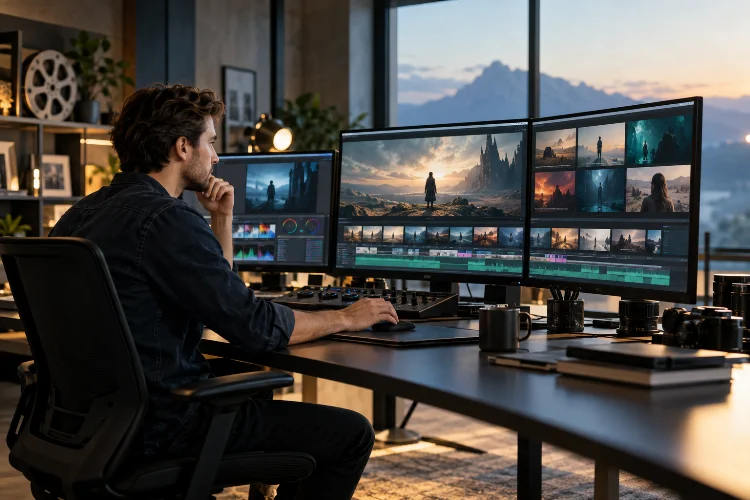
Ever noticed how some entertainment websites can turn a simple movie scene into an engaging article that keeps readers exploring for several minutes?
Meanwhile, other platforms publish dozens of random clips and barely give audiences a reason to stay.
What’s the difference?
It’s not necessarily the number of videos, the popularity of the movies, or even the production quality of the clips.
The difference often comes down to thoughtful editorial curation.
Choosing the right cinematic moments, organizing them around meaningful topics, and presenting them with useful context can transform ordinary video collections into valuable storytelling resources.
That’s where advanced movie clip curation strategies for editorial platforms become particularly important.
Modern digital publishers need to think beyond uploading memorable scenes. They must consider narrative relevance, audience interests, content discoverability, licensing requirements, and long-term editorial value.
A carefully selected movie clip can support film criticism, explain cinematic techniques, illustrate cultural trends, or introduce readers to unfamiliar filmmaking styles.
Whether you’re managing an entertainment magazine, film analysis blog, streaming publication, or multimedia content platform, effective curation can make your editorial experience significantly more engaging.
Let’s explore how to build a smarter approach.
1. Understanding Strategic Movie Clip Curation
Movie clip curation isn’t simply collecting interesting scenes and placing them into an online gallery.
At its core, it’s an editorial process that involves selecting, evaluating, organizing, and contextualizing audiovisual material for a specific audience.
The goal is to create meaningful connections between cinematic content and the information readers are looking for.
Moving Beyond Random Clip Collections
Imagine visiting a film website featuring 100 clips from popular movies.
The scenes are entertaining, but they’re presented without descriptions, explanations, or any recognizable organization.
You might watch a few before getting bored.
Now imagine another website featuring just 20 clips, carefully grouped into topics such as cinematic suspense, visual symbolism, memorable dialogue, and innovative camera movement.
Each clip includes an insightful explanation of why the scene matters.
Suddenly, the smaller collection feels much more valuable.
That’s because strategic curation emphasizes relevance rather than sheer volume.
Creating Clear Editorial Objectives
Every curated collection should serve a recognizable purpose.
An educational film publication might prioritize scenes demonstrating cinematography, lighting, editing, and narrative structure.
An entertainment news platform could focus on moments connected to recent interviews, anniversaries, restorations, or emerging discussions.
Meanwhile, a film history website might organize clips around influential directors, filmmaking movements, or changing genre conventions.
These objectives influence which scenes deserve attention.
Without a defined editorial direction, even an impressive video library can become difficult to navigate and maintain.
Building Value Through Original Commentary
One of the strongest ways to differentiate a movie clip platform is by adding meaningful editorial interpretation.
Instead of describing a clip as an unforgettable scene, explain what makes it effective.
Discuss its dramatic purpose, visual language, character development, or cultural significance.
Google’s guidance on helpful, people-first content emphasizes original information, analysis, and material that genuinely satisfies audience needs.
For editorial publishers, the lesson is straightforward: video alone isn’t necessarily the product.
The explanation surrounding the video can be just as important.
2. Developing an Advanced Clip Selection Framework
Selecting the right material requires more than relying on personal preferences or choosing scenes from famous movies.
A consistent evaluation framework makes editorial decisions easier to explain and improves quality across larger content libraries.
Evaluating Narrative and Thematic Relevance
Start by identifying the main editorial question a clip should answer.
For example, an article exploring suspense might compare scenes where filmmakers create tension through silence, restricted information, or delayed revelation.
A guide to visual storytelling could examine how directors use framing and character movement to communicate emotional relationships.
The selected moment should demonstrate the concept clearly.
A popular action sequence might attract attention, but it won’t necessarily contribute useful insight to an article about subtle acting techniques.
That’s why editorial relevance should outweigh popularity when selecting supporting footage.
Assessing Visual and Analytical Value
The best clips often contain several layers of cinematic information.
Consider a scene from Parasite (2019), where architectural space, character positioning, and movement contribute to the film’s exploration of social inequality.
A carefully chosen excerpt could support an analysis of production design, blocking, class symbolism, or visual composition.
That makes the scene valuable for multiple editorial topics, although each use would require appropriate rights assessment.
When evaluating potential selections, consider whether the clip offers a clear analytical focus and enough visual evidence to support the accompanying commentary.
Creating a Practical Scoring System
Editorial teams can simplify selection by assigning scores to several criteria.
For example, a hypothetical assessment could allocate 35% of the score to topic relevance, 25% to narrative or visual significance, 20% to originality of editorial insight, 10% to technical quality, and 10% to rights readiness.
Each candidate receives a rating from one to five for every criterion.
The weighted results help editors compare possible selections without depending entirely on intuition.
These percentages aren’t an established industry standard. They’re an illustrative starting point that teams can adjust to match their priorities.
Importantly, legal approval should remain a separate mandatory publishing requirement rather than something that a high editorial score can override.
3. Managing Copyright, Licensing, and Editorial Integrity
Copyright management is one of the most important parts of movie clip publishing.
A scene being available online doesn’t automatically mean a website has permission to download, modify, or republish it.
Film footage can involve multiple rights holders, contractual restrictions, and separate rights covering music or other material.
Understanding Licensing and Fair Use
In the United States, fair use may apply to certain uses of copyrighted material for purposes such as criticism, commentary, scholarship, teaching, or news reporting.
However, it isn’t an automatic exemption for editorial websites.
The analysis considers four factors: the purpose and character of the use, the nature of the original work, the amount and significance of the material used, and the potential effect on the market for the original.
A short excerpt used in a detailed critical discussion may present a different legal situation from a standalone compilation designed primarily for entertainment.
There is no universal rule saying that a clip becomes safe simply because it lasts fewer than a certain number of seconds.
Copyright exceptions also vary between countries.
For international editorial platforms, obtaining suitable permission or specialist legal advice may be necessary.
Choosing Legitimate Sources
Professional publishers should prioritize material they have permission to use.
Possible sources include studio-approved promotional assets, directly licensed footage, authorized embedding services, appropriately licensed archival collections, and material genuinely in the public domain.
Creative Commons resources can also be useful when the license permits the intended use.
However, different Creative Commons licenses have different restrictions.
Some prohibit commercial reuse, while others restrict adaptations.
Publishers should verify the actual license terms rather than assuming every freely accessible file is available for unrestricted redistribution.
Creating a Rights Documentation Workflow
Every selected clip should have a documented rights status before publication.
Useful records include the source URL, copyright owner, license or permission documentation, permitted territories, approved distribution channels, expiration dates, and any restrictions on editing.
If several editorial teams use the same video library, this information should be accessible without requiring editors to contact one another seperately.
Clear documentation reduces the risk of accidentally republishing footage outside its permitted use.
Creative Commons also recommends the TASL attribution approach: Title, Author, Source, and License.
Attribution remains important, but providing credit alone doesn’t replace permission when permission is required.
4. Organizing Clips With Metadata and Editorial Taxonomy
A successful editorial library needs a reliable organizational structure.
Without one, valuable clips can become buried beneath inconsistent titles, duplicate entries, and confusing categories.
This problem becomes more serious as a platform expands.
Building a Meaningful Metadata System
Metadata describes the content and characteristics of a video asset.
For a movie clip library, useful fields might include the film title, release year, director, scene description, timestamp, duration, genre, cinematic techniques, editorial topic, and rights status.
Imagine a scene categorized under suspense, low-key lighting, dramatic irony, and psychological thriller.
Readers interested in any of those subjects could potentially discover the same clip through different editorial pathways.
This flexibility makes a well-structured library more valuable than one organized exclusively by movie title.
Developing a Consistent Tagging Structure
Tags should help people navigate content rather than simply repeat popular search keywords.
For example, “Cinematography” might function as a broad category, while “Deep Focus,” “Tracking Shots,” and “Low-Angle Framing” serve as more specific tags.
The relationship between categories and tags should remain predictable.
Avoid creating multiple nearly identical labels such as “Camera Movement,” “Moving Camera,” and “Camera Motion” unless there’s a genuine editorial reason.
A controlled vocabulary makes browsing easier and reduces inconsistent metdata across the platform.
Combining Human Judgment With Automation
Automated systems can help identify visual objects, generate transcript drafts, detect scene changes, and suggest descriptive labels.
These capabilities become particularly useful when processing large collections.
However, automated classification shouldn’t replace editorial judgment.
A system might identify a character standing alone in a hallway but fail to recognize that the composition communicates emotional isolation.
Human editors provide interpretation, verify accuracy, and decide which details are genuinely relevent to the intended audience.
The most practical approach combines automated assistance with human review.
5. Designing Engaging Editorial Experiences Around Movie Clips
Even carefully selected footage can underperform when the surrounding presentation feels confusing or incomplete.
Editorial context, navigation, accessibility, and page design all influence whether audiences find the material useful.
Give Every Clip a Clear Editorial Purpose
A video should contribute something specific to the page on which it appears.
If an article discusses cinematic tension, introduce the clip by explaining what readers should observe.
For instance, an analysis of an interrogation scene might ask readers to notice how camera distance and actor positioning shift throughout the confrontation.
After the video, the article can explain how those choices affect the audience’s perception of authority.
This approach turns passive watching into an interactive learning experience.
Use Contextual Descriptions Instead of Generic Captions
A caption saying “Amazing scene from a classic film” provides almost no useful information.
A stronger description explains what happens and why it matters.
For example, an editorial caption could explain that a confrontation uses alternating close-ups to emphasize competing emotional perspectives.
These descriptions also help establish connections between individual clips and the broader article.
Keep the writing conversational and avoid overwhelming readers with unnecessary technical terminology.
Make Accessibility Part of the Publishing Process
Video accessibility should never be treated as an optional extra.
The World Wide Web Consortium’s accessibility guidance calls for captions for prerecorded synchronized media containing relevant audio, subject to the stated exceptions.
Good captions include meaningful dialogue and important non-speech sounds, not just spoken words.
Readable transcripts, accessible playback controls, and visual descriptions where appropriate can further improve the experience.
These features benefit people with disabilities and can also help users consuming content in noisy or sound-sensitive environments.
Build Thematic Collections and Viewing Paths
Instead of displaying unrelated recommendations beneath every video, connect clips through meaningful themes.
A reader exploring film noir lighting might naturally want to examine shadow-heavy compositions, expressive contrast, and modern neo-noir examples.
A curated viewing path allows that person to explore progressively deeper material.
The result feels closer to a guided editorial journey than an endless collection of disconnected videos.
6. Improving Video SEO and Content Discoverability
Search visibility matters because even excellent editorial material has limited impact if audiences can’t find it.
However, effective video SEO isn’t simply about adding keywords to every available field.
It’s about helping search engines and readers understand the purpose, relevance, and structure of the content.
Optimize Titles and Descriptions Naturally
Each clip or editorial page should have a descriptive, distinctive title.
For example, “How Parasite Uses Architecture to Show Class Division” provides a clearer promise than “Best Parasite Movie Scene.”
The first title identifies a specific analytical topic and gives readers a reason to engage.
Descriptions should explain the clip’s relevance while naturally incorporating related search phrases.
Avoid repeating the same exact keywords excessively.
Semantic variety helps communicate the subject more naturally.
Understand Video Pages and Structured Data
Google Search Central recommends making videos discoverable through supported HTML elements, accessible thumbnails, and consistent metadata.
For dedicated video watch pages, properly implemented VideoObject structured data can help describe the video to search engines.
Relevant properties include the video name, thumbnail URL, upload date, description, and other supported details.
Google also supports Clip structured data for identifying important moments within qualifying videos.
However, an editorial article containing a supporting video isn’t necessarily considered a dedicated watch page.
Publishers should choose page structures based on the content’s actual purpose rather than forcing every article into a video-first format.
Connect Clips With Internal Links
Internal linking helps audiences move between related topics.
An article explaining match cuts could link to an analysis of visual transitions, a guide to continuity editing, and an examination of famous cinematic examples.
These connections create a stronger thematic structure across the website.
They also encourage readers to explore further without relying entirely on generic recommendation algorithms.
Search Console can help publishers monitor how their pages and eligible videos perform in Google Search.
Still, visibility isn’t guaranteed simply because structured data or metadata is present.
7. Measuring Performance and Maintaining Editorial Quality
Publishing a curated collection is only the beginning.
Successful platforms regularly evaluate which clips engage audiences, which editorial formats provide value, and which collections need improvement.
Measure More Than Total Views
View counts can reveal interest, but they don’t tell the complete story.
A clip might receive thousands of impressions because it features a famous actor while generating little meaningful engagement.
Another might attract fewer visitors but encourage deeper reading and exploration.
Useful measurements include video starts, watch completion rates, average viewing time, article engagement, related-content clicks, and returning visitors.
Editors should interpret these signals together rather than treating one metric as a universal measure of success.
Learn From Audience Behavior
Imagine two editorial articles covering similar filmmaking techniques.
One uses a short clip followed by a detailed scene breakdown, while the other embeds a longer sequence with minimal explanation.
If the first consistently encourages more readers to explore related articles, that pattern may suggest the audience values additional context.
However, performance differences could also reflect topic interest, traffic sources, or placement.
Controlled comparisons and consistent measurement periods help avoid misleading conclusions.
Maintain a Regular Editorial Audit
Video libraries require ongoing maintenance.
Permissions can expire, external embeds can disappear, links can break, and older descriptions may become inaccurate.
Periodically review the rights records, playback functionality, captions, metadata, and editorial relevance of published material.
For larger teams, assign clear responsibility for updates and maintain a consistant review schedule.
This prevents outdated material from gradually reducing the quality of the platform.
Treat Curation as a Long-Term Editorial Asset
The strongest collections aren’t necessarily those that publish the greatest number of clips.
They’re the ones that develop a recognizable perspective and remain useful over time.
A thoughtfully maintained library of cinematic techniques, director studies, and scene breakdowns can support future articles, educational resources, and thematic collections.
Every new addition should strengthen that wider editorial structure.
Over time, this approach creates a more coherent resource for readers who want to understand cinema rather than simply consume isolated highlights.
Effective movie clip curation combines creative judgment, editorial structure, technical organization, and responsible publishing practices.
The goal isn’t to collect as many recognizable scenes as possible. It’s to select meaningful cinematic moments and present them with context that helps audiences understand why they matter.
Strong selection criteria improve relevance, clear metadata supports discovery, and accessible presentation makes the experience more useful.
Meanwhile, responsible rights management and ongoing performance reviews support long-term sustainability.
For editorial platforms, carefully curated video content can become a valuable resource for film criticism, education, and cultural discussion.
Ready to improve your movie clip publishing strategy?
Start by reviewing your existing video library, identifying your strongest editorial themes, and developing a consistent selection and documentation process.
A smaller, better-organized collection might deliver far more value than hundreds of clips published without a clear purpose.
