
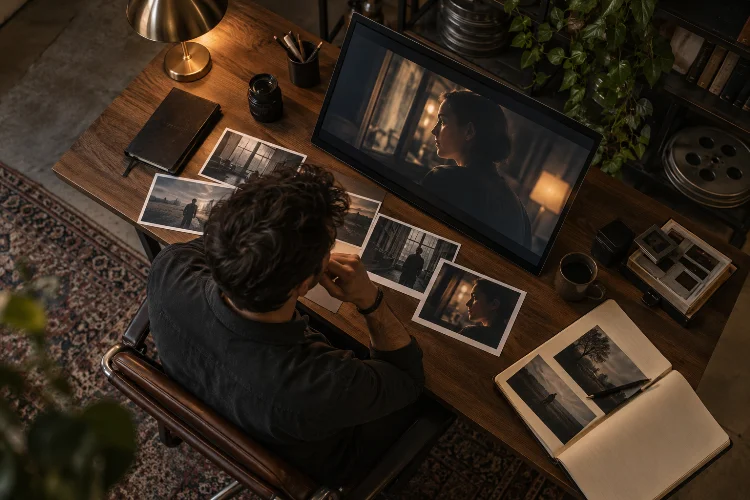
Ever watched a movie and noticed that one seemingly ordinary scene says more about the entire story than its biggest action sequence?
Maybe it’s a quiet conversation between two characters, an uncomfortable pause before a confession, or a camera movement that subtly changes how we understand someone’s intentions.
These moments might not become viral clips or appear in movie trailers, but they often contain the most interesting storytelling details.
That’s why choosing the right scene matters so much when creating meaningful film analysis content.
Strategic movie scene selection for deeper film analysis content isn’t about collecting the most popular or visually impressive moments.
It’s about identifying sequences that reveal how filmmakers construct meaning through narrative decisions, cinematography, editing, performance, and sound.
A carefully selected scene can uncover character motivations, explain recurring visual themes, or demonstrate how small cinematic details influence audience emotions.
Whether you’re writing a film criticism blog, producing video essays, or managing an editorial platform dedicated to cinema, smarter scene selection can dramatically improve the quality of your work.
Let’s explore how to identify cinematic moments that deserve a closer look.
1. Why Strategic Scene Selection Matters in Film Analysis
Choosing a movie scene might sound simple.
Find something memorable, replay it a few times, and start explaining what happens.
Unfortunately, that approach often produces shallow analysis because an entertaining scene isn’t necessarily the most revealing one.
Popular Scenes Aren’t Always the Most Meaningful
Think about a blockbuster movie featuring enormous explosions, dramatic battles, and spectacular visual effects.
These sequences can be exciting, but their appeal might depend primarily on spectacle rather than complex storytelling.
Meanwhile, a conversation lasting less than two minutes could reveal more about the film’s central conflict.
The difference lies in analytical potential.
An effective scene provides opportunities to examine how different filmmaking decisions contribute to narrative meaning.
For example, an apparently friendly discussion might gradually become threatening through changing camera angles, uncomfortable silences, and increasingly restrictive framing.
Those details create several meaningful angles for analysis.
Scene Selection Shapes Editorial Quality
The material you choose influences the depth of your entire article.
If a scene offers only one obvious observation, your analysis may become repetitive.
But when a sequence contains layered performances, deliberate visual choices, and significant narrative development, you have much more to explore.
This is particularly important for editorial websites publishing long-form film criticism.
Readers usually want more than a description of events they’ve already watched.
They want explanations that help them recognize details, patterns, and meanings they might have overlooked.
Start With a Clear Analytical Question
Before choosing footage, identify the question your article intends to answer.
Perhaps you’re exploring how directors communicate social inequality through architecture.
Or maybe you want to investigate why certain horror scenes feel disturbing without showing explicit violence.
Once you’ve established the analytical question, scene selection becomes considerably easier.
Instead of choosing randomly, you can identify moments that provide convincing visual and narrative evidence.
2. Identifying Narrative Turning Points and Dramatic Structure
Great film scenes usually serve a dramatic purpose.
They change what characters know, transform relationships, increase tension, or establish new expectations for the audience.
Recognizing these developments helps identify scenes with strong narrative value.
Look for Meaningful Character Decisions
One effective selection strategy involves finding moments when a character makes an important choice.
That choice doesn’t need to involve a dramatic confrontation or life-changing announcement.
Sometimes, simply refusing to answer a question communicates an important emotional shift.
Consider a character who spends much of a film avoiding responsibility.
A scene where that person finally admits a mistake might represent a significant turning point, even if the moment is visually understated.
The dramatic value comes from the relationship between the decision and the character’s larger journey.
When examining a potential clip, ask what changes because the scene exists.
If the answer is unclear, investigate whether the sequence instead develops atmosphere, character relationships, or thematic understanding.
Recognize Narrative Beats
Narrative beats are meaningful shifts in dramatic action, emotional direction, or audience understanding.
A conversation might begin as a friendly exchange before turning into an accusation.
The accused character then discovers that the other person already knows the truth.
Suddenly, the balance of power changes.
Each development introduces a new dramatic beat that can be examined through performance, dialogue, framing, and editing.
Scenes containing several clear beats often provide excellent material for detailed breakdowns.
However, don’t automatically assume more dramatic changes create a better scene.
A carefully sustained emotional moment can be just as revealing.
Consider What Happens Before and After
Analyzing a scene without understanding its surrounding narrative can produce misleading interpretations.
A character’s silence might indicate fear, confidence, guilt, or emotional exhaustion.
Its meaning depends partly on what the audience already knows.
Before selecting a clip, examine the sequence immediately preceding it and the consequences that follow.
This context helps establish whether the moment introduces new information, reinforces an existing idea, or transforms our understanding of earlier events.
3. Selecting Scenes With Rich Cinematography and Visual Storytelling
Narrative structure is important, but visual language often determines whether a scene offers enough material for deeper interpretation.
Filmmakers communicate through framing, lighting, movement, production design, and relationships within the image.
These techniques can make even an ordinary interaction visually meaningful.
Pay Attention to Camera Framing
Camera framing influences how audiences perceive characters and their surroundings.
A close-up can emphasize subtle emotional reactions, while a wide shot can reveal isolation or a character’s relationship with the environment.
However, these meanings aren’t automatic.
A close-up might communicate intimacy during a romantic scene but feel threatening during an interrogation.
When selecting footage, look for changes in framing that correspond with dramatic developments.
For instance, a conversation might begin with two characters sharing the frame before gradually separating them into individual close-ups.
That visual progression could reinforce increasing emotional distance.
Examine Blocking and Character Positioning
Blocking describes how performers are positioned and move within a scene.
Physical distance, body orientation, and movement can communicate relationships that dialogue never directly explains.
Imagine two characters discussing a difficult decision.
One remains standing near a doorway while the other sits comfortably in the center of the room.
The arrangement may suggest differences in authority, security, or emotional commitment.
If those positions change during the conversation, the movement might communicate a shift in power.
Scenes featuring meaningful blocking are particularly useful because they connect physical behavior with character psychology.
Look for Visual Motifs and Symbolism
Some films repeatedly use specific objects, colors, architectural details, or compositional patterns.
These recurring elements can develop meaning across different scenes.
For example, a doorway might initially represent opportunity but later become associated with confinement.
Recognizing that transformation requires comparing several moments rather than analyzing a single image independently.
When choosing a scene, consider whether its visual details connect to patterns established elsewhere in the film.
These relationships often provide stronger evidence for thematic interpretation.
4. Evaluating Sound Design, Editing, and Performance
A movie scene isn’t just a sequence of images.
Sound, editing rhythm, dialogue, and performance all contribute to how audiences experience cinematic events.
Ignoring these elements can result in incomplete analysis.
Sound Can Reveal Hidden Emotional Layers
Imagine a character sitting alone in a room.
The image remains almost motionless, but distant footsteps gradually become louder.
Without showing another person, the filmmaker creates anticipation through sound.
That change can transform a peaceful composition into a suspenseful moment.
Scenes where audio contributes meaningfully to narrative tension often make excellent choices for close analysis.
Pay attention to ambient noise, music, dialogue delivery, and intentional silence.
The relationship between what audiences see and hear can reveal important storytelling decisions.
Editing Rhythm Shapes Audience Experience
Editing determines how images are arranged and how long viewers remain with particular moments.
Rapid cuts can create urgency, while extended shots may encourage observation or build discomfort.
However, pacing should always be interpreted within its dramatic context.
A long take might feel peaceful in one film and deeply unsettling in another.
Look for sequences where editing rhythm changes alongside emotional developments.
These transitions provide useful evidence for explaining how filmmakers guide audience attention.
Subtle Performances Deserve Attention
One common mistake is prioritizing scenes featuring exaggerated emotional performances.
Shouting, crying, and dramatic gestures are easy to recognize, but restrained acting can offer equally valuable material.
A hesitant glance, delayed response, or slight change in posture might reveal an internal conflict.
Careful analysis can explore how these small details interact with camera placement and editing.
Sometimes, the most revealing performance occurs when a character appears to do almost nothing.
5. Real Film Examples: Choosing Scenes That Reveal Deeper Meaning
Understanding selection principles becomes easier when examining how they apply to actual movies.
Several films demonstrate that analytically rich scenes aren’t always the loudest or most spectacular.
Parasite: Choosing Scenes That Reveal Social Hierarchy
Bong Joon-ho’s Parasite (2019) provides excellent material for analyzing the relationship between architecture and social inequality.
The film repeatedly contrasts elevated living spaces with cramped, lower-level environments.
A particularly useful selection would be a sequence involving the Kim family’s movement between different physical and social spaces.
Stairs, windows, entrances, and architectural boundaries become essential parts of the storytelling.
An analysis could examine how vertical movement reinforces the film’s exploration of economic status.
Instead of simply explaining that the movie discusses class inequality, the article could demonstrate how production design communicates that theme visually.
The key is choosing a sequence where the relationship is observable rather than relying exclusively on general statements about the film.
In the Mood for Love: Selecting Quiet Emotional Moments
Wong Kar-wai’s In the Mood for Love (2000) offers a very different analytical opportunity.
Much of the film’s emotional power emerges through restrained performances, repeated encounters, and carefully constructed visual compositions.
A brief encounter between the central characters near a narrow staircase can provide material for examining physical proximity, longing, and social restraint.
The characters communicate remarkably little through direct conversation.
Instead, movement, music, and subtle glances establish emotional meaning.
This is precisely why quiet scenes can be valuable for editorial analysis.
They encourage readers to look beyond spoken dialogue and recognize how cinematic form expresses complex feelings.
Get Out: Finding Scenes With Multiple Analytical Layers
Jordan Peele’s Get Out (2017) demonstrates how psychological horror can emerge from ordinary environments and familiar objects.
The hypnosis sequence involving Chris and Missy offers several analytical possibilities.
A seemingly normal conversation becomes increasingly disturbing through controlled dialogue, performance, sound, and visual effects.
The repeated sound of a spoon against a teacup becomes associated with psychological manipulation.
Meanwhile, the sequence’s movement into the Sunken Place introduces a powerful visual representation of lost control.
An article could examine the scene through sound design, symbolism, performance, or narrative perspective.
Because the sequence supports several different interpretations grounded in observable techniques, it offers strong potential for deeper analysis.
6. Building a Practical Movie Scene Selection Workflow
Understanding cinematic theory is useful, but editorial teams also need a process they can repeat across different films.
A clear workflow makes scene selection more consistent and prevents articles from relying entirely on personal preference.
First Viewing: Understand the Entire Film
Watch the movie without constantly stopping to take technical notes.
Focus on the story, character relationships, major conflicts, and emotional progression.
Pay attention to moments that produce strong reactions or introduce important narrative changes.
After the viewing, identify the film’s central themes and consider which sequences might demonstrate them.
Avoid selecting every scene immediately.
Give yourself enough time to recognize how individual moments contribute to the complete narrative.
Second Viewing: Create a Candidate Scene List
Revisit promising sequences and record their approximate timestamps.
For each candidate, write a short description of its dramatic purpose and distinctive cinematic elements.
You might note that a particular conversation uses restrictive framing to communicate emotional pressure.
Another might employ sound and editing to create uncertainty.
A third could establish a recurring visual motif that becomes important later.
This preliminary review makes it easier to compare scenes with different analytical strengths.
Third Viewing: Evaluate Analytical Potential
A simple scoring model can help prioritize candidates.
For example, assign 30% of the total score to narrative significance, 25% to visual storytelling, 20% to thematic relevance, 15% to technical richness, and 10% to editorial originality.
Rate each category from one to five and calculate a weighted score.
These percentages are only an illustrative editorial framework, not an established academic standard.
Their purpose is to encourage consistent decisions rather than determine artistic value mathematically.
A scene that scores highly across multiple dimensions may support a more substantial article.
However, exceptional scenes with one particularly strong quality shouldn’t be automatically excluded.
Fourth Viewing: Define the Right Clip Boundaries
Once you’ve chosen a scene, identify its meaningful beginning and ending.
Starting too late might remove information necessary to understand the conflict.
Ending too early could eliminate the decision or reaction that completes the dramatic moment.
Rather than choosing an arbitrary duration, define the excerpt around a coherent analytical unit.
A 45-second interaction might contain everything needed to explain a particular camera technique.
A longer sequence may be necessary to demonstrate gradual changes in power or emotional tension.
When publishing actual footage, duration and context must also be evaluated against the applicable rights and permissions.
Final Review: Separate Observation From Interpretation
Before writing, distinguish what happens onscreen from what you believe it means.
For example, “the character moves toward the doorway” is an observation.
“The movement communicates a desire to escape the confrontation” is an interpretation.
The second statement becomes stronger when supported by dialogue, performance, framing, or earlier narrative information.
This distinction helps prevent overanalysis.
Not every background object, color choice, or camera movement carries symbolic significance.
Strong criticism depends on evidence rather than imaginative speculation.
7. Turning Selected Scenes Into Engaging Editorial Content
Choosing the right clip is only the beginning.
The next challenge is transforming your observations into content that readers can understand, enjoy, and discover through search engines.
Build Each Article Around a Specific Argument
Avoid writing generic articles that simply describe everything happening in a movie.
Instead, develop a clear analytical focus.
For example, an article titled “How Parasite Uses Vertical Space to Explore Class Inequality” communicates a specific idea.
The selected scenes then become evidence supporting that argument.
This approach creates a more coherent reading experience and helps distinguish original analysis from ordinary plot summaries.
Create Search-Friendly Content Without Keyword Stuffing
Film analysis articles can naturally incorporate related phrases such as cinematic storytelling, scene breakdown, visual symbolism, narrative structure, and character development.
Use these terms when they contribute meaningfully to the discussion.
Don’t repeat the same keyword in every paragraph.
Google’s guidance on people-first content emphasizes original analysis, useful information, and genuine value for readers.
A strong SEO strategy should therefore support editorial quality rather than replace it.
Respect Copyright When Publishing Clips
Using scenes for criticism or commentary doesn’t automatically guarantee permission to republish copyrighted footage.
In the United States, fair use is evaluated using several factors, including the purpose of the use, the nature of the work, the amount used, and potential market effects.
A short excerpt isn’t automatically lawful simply because it’s brief.
Rules also differ internationally.
Editorial teams should verify licenses, platform embedding permissions, or applicable legal exceptions before publishing copyrighted material.
When permissions are unavailable, detailed written analysis may be a more appropriate alternative.
Encourage Deeper Reader Engagement
An effective article should help readers notice something they might have missed during casual viewing.
Instead of stating that a scene feels tense, identify the framing, sound, performance, or editing decision contributing to that feeling.
Use concise explanations and specific observations.
You can also connect related articles through internal links, allowing readers to explore similar filmmaking techniques across different movies.
Over time, a collection of carefully researched scene analyses can become a valuable educational resource.
Strategic movie scene selection is about recognizing cinematic moments that offer meaningful opportunities for interpretation.
The strongest choices aren’t necessarily famous action sequences or emotionally dramatic confrontations. Often, quiet exchanges, subtle movements, and carefully constructed visual relationships reveal more about a filmmaker’s intentions.
By examining narrative turning points, cinematography, sound, editing, and performance, you can identify scenes that support deeper, evidence-based analysis.
A consistent selection workflow also helps transform individual observations into stronger editorial content.
Ready to improve your next film analysis article?
Choose a movie you know well, identify three scenes with different storytelling strengths, and compare how each contributes to the film’s larger themes.
The right scene could reveal an entirely new perspective on a story you’ve watched countless times.
